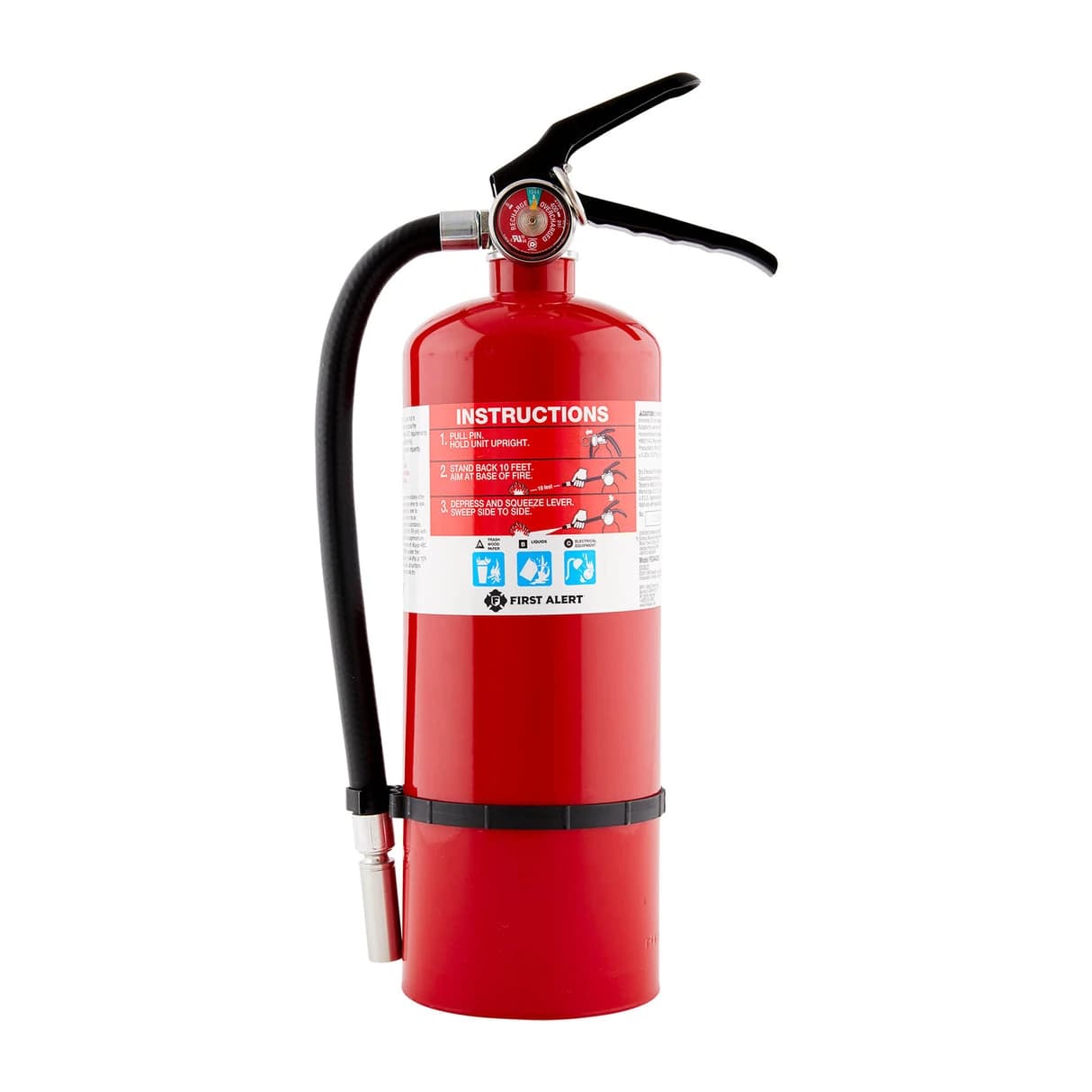
What the PRO5 is designed to fight
First Alert identifies the PRO5 with underlying model FE3A40GR and a 3-A:40-B:C fire class. The manual explains Class A as small fires involving wood, paper, cloth, rubber, and some plastics; Class B as grease, oil, gasoline, kerosene, and other flammable liquids; and Class C as live electrical equipment. That makes the PRO5 a broad ABC choice for many garage and household scenarios, not a universal answer for every shop hazard. The rating describes the classes and test size; it does not turn the extinguisher into permission to confront a large or spreading fire.
Rechargeable construction and readiness
The current product page describes a portable, rechargeable extinguisher with a heavy-duty metal head, metal pull pin, safety seal, and an easy-to-read, corrosion-resistant color-coded gauge. Its label is described as chemical resistant and waterproof and carries four-step instructions. Rechargeability is the ownership differentiator: First Alert says it can be recharged by a certified professional if used. The manual adds that an authorized fire-equipment dealer must refill it with the same chemical originally supplied. This is not a “use it and forget it” item; pressure, seal, nozzle condition, corrosion, and inspection records are part of ownership.
Mounting and placement in a shop
First Alert lists a heavy-duty wall mounting bracket with the product and the support chart identifies BRACKET5 as fitting PRO5 and FE3A40GR, for large 5-pound extinguishers. The mounting guidance says to use a wooden stud or other solid surface, select fasteners for that surface, keep the label outward, and secure the strap. The manual calls for a location in sight, easy to reach, near an exit or escape route, and 3-1/2 to 5 feet above the floor. For an automotive workspace, that argues for a visible access point—not inside a locked cabinet or behind the most likely fire source.
Practical emergency use, with firm limits
The supplied manual says to fight only a small fire when there is a clear escape path, stay near an exit, avoid smoke and heated fumes, and evacuate if the fire is too hot or smoky to approach safely. Its operating sequence is to remove the extinguisher from the mount, break the seal and pull the pin, stay at least 10 feet back when possible, aim at the base, press the lever, and sweep side to side. First Alert’s support article summarizes the same PASS sequence. These are safety directions, not a substitute for training or emergency services.
Agent, pressure, and material consequences
The FE3A40GR manual identifies the extinguishing medium as a dry powder and describes the Class A/B/C applications. The product page emphasizes the metal head and gauge rather than a disposable plastic construction, while the manual warns that the contents are under pressure, must not be punctured or burned, and can rupture if exposed above 150°F. After use, First Alert says to ventilate the area and avoid breathing the powder. That makes the PRO5 a sensible readiness product for a shop, but not a clean-up-free response: protect electronics and plan for residue removal and professional recharge.
Inspection, service, and model identity
The support page labels the product “FE 5LB PRO SERIES FE3A40GR” and “Model: PRO5,” which is the exact identity used here rather than a neighboring PRO10, Home2Pro, or auto extinguisher. The manual recommends weekly inspection: check that the gauge is in the green, look for damage or corrosion, confirm the safety seal remains intact, and keep the nozzle unobstructed. It also says to record inspection and maintenance dates and return the extinguisher to its mount after inspection. First Alert lists a 12-year limited warranty on the current product page, but warranty coverage is not a substitute for service.