The size range needs reading literally
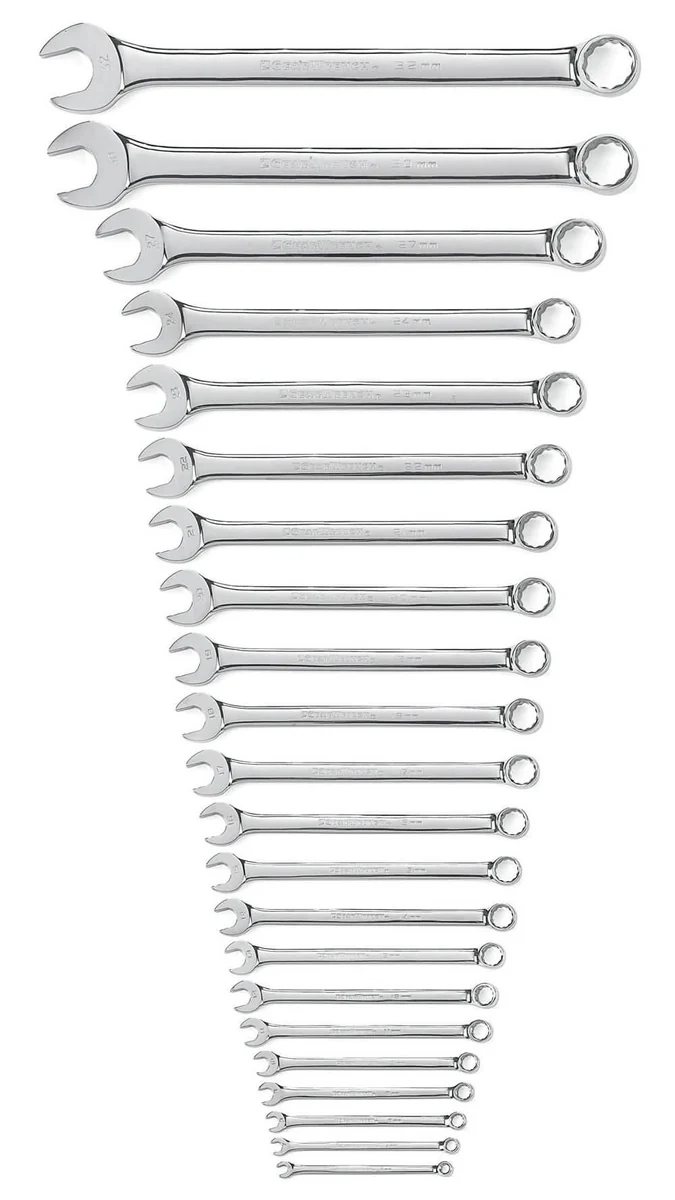
The documented 22-piece selection covers 6–24 mm plus 27, 30 and 32 mm. That is broad coverage, but not every integer between its smallest and largest tool. A missing large size can determine whether the set fits a particular chassis job. Compare the actual list with recurring vehicle requirements rather than assuming the outer range tells the whole story.
Long pattern and offset have practical tradeoffs
A longer handle provides reach and a different working position from a short wrench, while the 15-degree box offset can help clear nearby surfaces. Those benefits depend on the approach to the fastener. In a tight engine bay, length can also prevent the wrench from swinging. Check whether a socket, shorter wrench or ratcheting combination wrench would provide better control in the available space.
Twelve-point box ends are not flare-nut heads
The box-end arrangement and open end support ordinary fastening and counterholding. A hydraulic line that prevents a closed box end passing over it needs a suitable line-fitting tool, not a forced fit or an assumption that every open end is equivalent. The 81906 flare-nut set is the relevant comparison for its supported metric fittings. Use exact sizes and avoid damaging precision sealing connections.
Compare ratcheting convenience with conventional access
GEARWRENCH 9416 trades the conventional box end for a non-reversing ratcheting head and has a different size list. The better choice depends on whether repeated repositioning or head clearance is your main problem. The 81916’s tool roll helps organise a broad selection, but carrying every large size may be unnecessary for a mobile kit. Build around work you can identify rather than buying solely for the maximum size.