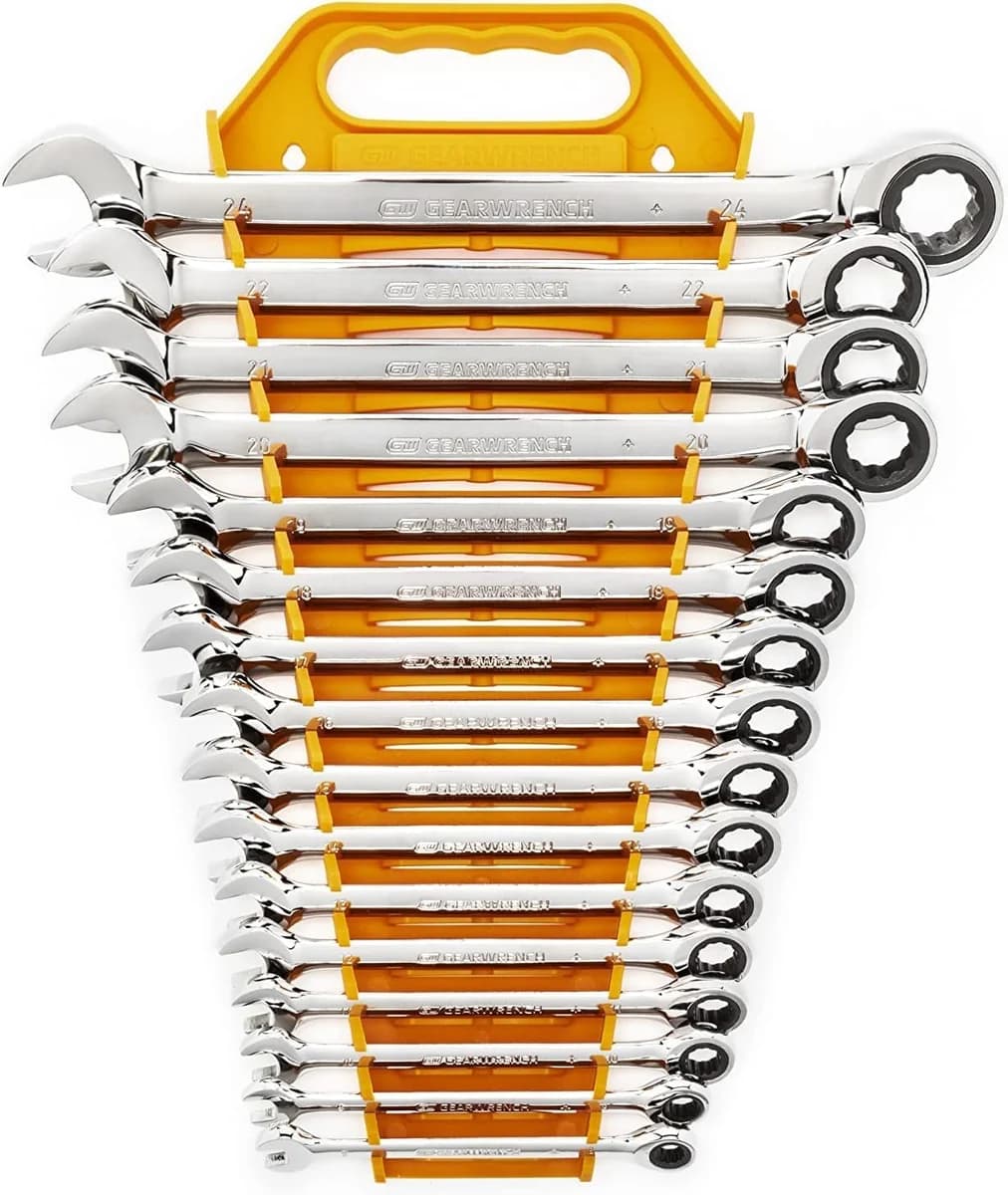
The useful difference from a conventional wrench
The 9416 provides 72-tooth ratcheting box ends with a nominal five-degree reset arc. That can reduce repeated lifting and reseating on suitable fasteners. The head still needs enough space to sit correctly and move through the working arc. A ratcheting mechanism does not compensate for an obstructed approach or wrong wrench size.
Non-reversing heads need an exit plan
The documented heads are fixed and non-reversing, so changing ratchet direction requires turning the wrench over. Consider whether backing a fastener out will trap the wrench against adjacent structure. This is a practical buying limitation, not merely a preference about a reversing lever. A conventional wrench or another access tool may be the better choice at that location.
Check the sixteen sizes
The set includes 8–22 mm and 24 mm, with 23 mm absent. Compare that with the broader but also non-contiguous 81916 selection. A bigger maximum size does not mean all intermediate tools are present. Check course requirements and your vehicle list so a missing size is identified before the job rather than handled with a near-fit tool.
Storage and the right neighbouring tools
The supplied rack helps organise the set in a working drawer. For line fittings, the 81906 provides a different profile and should not be replaced by this ratcheting box-end concept. For high-load manual loosening, select an appropriate tool and procedure rather than assuming the ratcheting mechanism is the right first approach. These are function-based choices within the same hand-tool kit.