SAE coverage and format
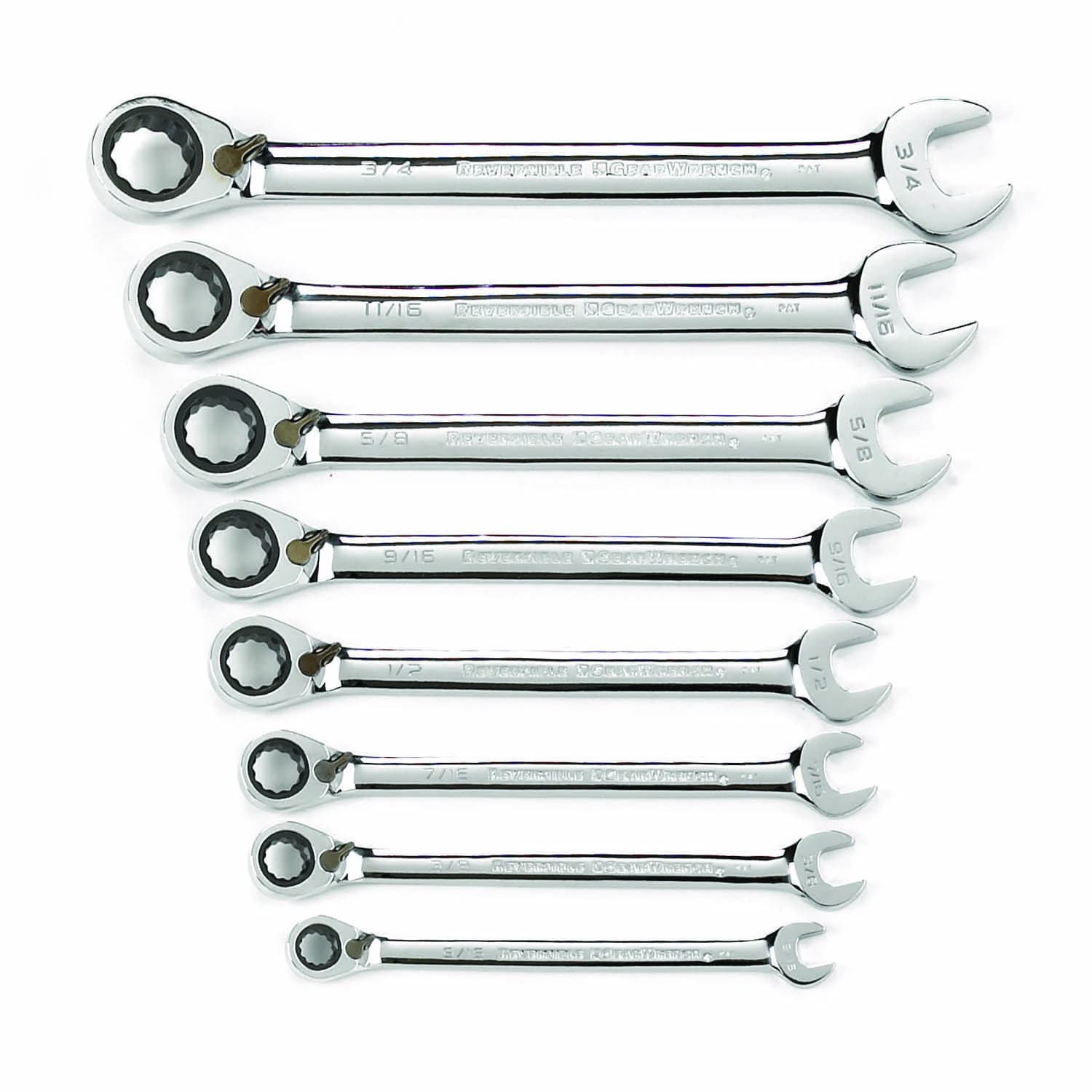
9533N contains eight standard-length combination wrenches: 5/16, 3/8, 7/16, 1/2, 9/16, 5/8, 11/16 and 3/4 inch. The manufacturer identifies the set as SAE, with an open end on one side and a 12-point ratcheting box end on the other. That makes the model easy to position in an SAE-focused drawer, but it is not a mixed or metric set. The rack organizes the eight pieces, while the size markings on the head and beam support quick selection during a job.
72-tooth ratcheting box end
The 72-tooth box end is specified to need as little as 5 degrees to move a fastener, compared with 30 degrees for a standard wrench. That low movement requirement is the main access argument for 9533N: it can ratchet where a conventional combination wrench would repeatedly need to be lifted and repositioned. The box end is 12-point, so the correct seating and fastener condition still matter. The product page does not claim impact-wrench compatibility; this is a hand-wrench mechanism for controlled manual work.
Reversing and fastener contact
A flush-mounted reversing lever lets the user change direction without removing the wrench from the fastener. The box end’s off-corner loading is intended to improve grip and reduce fastener rounding, while the 15-degree offset adds clearance for knuckles and nearby components. Those features work together: the lever preserves position, the offset changes hand clearance, and the contact geometry addresses load placement. They do not eliminate the need for full engagement or a correctly sized wrench, especially on damaged or heavily corroded hardware.
Access geometry
GEARWRENCH describes thin heads and beams for greater access in confined work areas. The 15-degree offset appears on both the open and box-end specification fields, and the set is not flexible. That is a predictable geometry: the offset can clear a nearby surface, but the wrench cannot bend around an obstruction. In an automotive bay, the result depends on the fastener’s approach and the space behind the hand. For deeper recesses or obstructed line-of-sight, a socket and extension may be the better format.
Material, finish and storage
The wrenches are made from alloy steel and finished in bright full-polish chrome. The page says the finish wipes clean and resists rust and corrosion, while the included wrench rack keeps the eight sizes organized. Catalog weight is 2.71 lb, and the manufacturer lists a full-lifetime warranty plus ASME and ANSI compliance claims. Those details support routine shop ownership, but they are not a substitute for inspecting the box end and open jaw after misuse. No independent strength or wear test was performed for this review.
Who should buy it
9533N is a coherent choice for a technician whose common work is SAE and who values ratcheting access over a large size range. It complements the 81206T ratchet set rather than duplicating it: a wrench can reach where a socket cannot, while a ratchet can accept extensions and different socket depths. The set’s boundaries are important—no metric sizes, no flex head, no impact application and only eight sizes. Buy it for the documented SAE coverage and low swing requirement, not as an all-purpose wrench system.