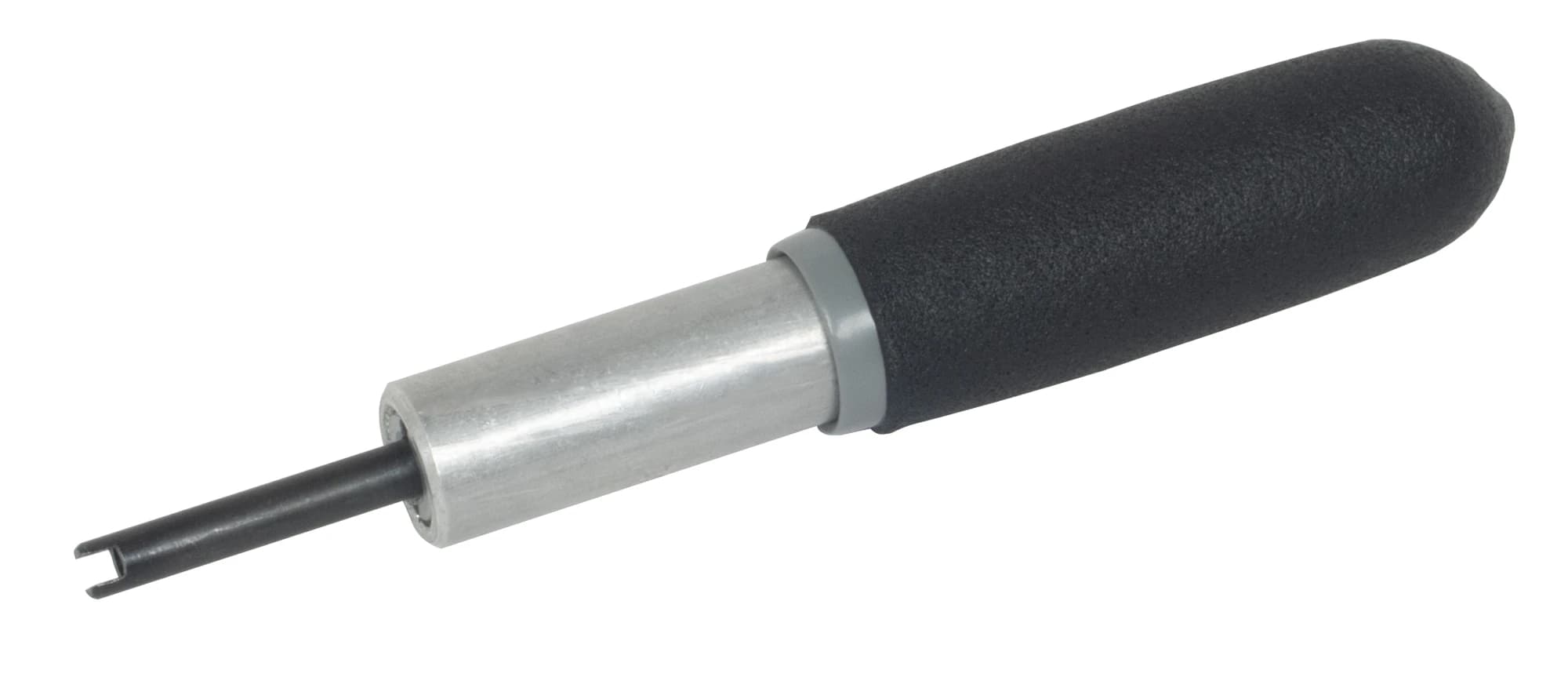
A very specific job, done deliberately
The 18810 is designed to install and remove valve cores, including on late-model vehicles with TPMS. Lisle sets the torque at 4 inch-pounds rather than offering a variable range. That narrow purpose is its main advantage: the technician does not have to estimate torque by feel when servicing the small core. It also defines the boundary. This tool does not replace a tire inflator gauge, a TPMS scan tool, or a wheel-fastener torque wrench, and the page gives no basis for assigning it any of those roles.
Why the preset matters
Lisle says the 4 inch-pound setting helps prevent both under- and over-torquing. The page connects that control to avoiding valve-core leaks that can produce low tire pressure and possible TPMS alerts. The cause-and-effect claim is practical and model-specific, but it is still a manufacturer description rather than an independent test result. This review therefore treats the preset as a documented design intention, not proof of measured accuracy. The source does not publish tolerance, calibration method, or a verification procedure.
Access is part of the design
The 18810’s slim design is explicitly intended to allow access in tight spots. That matters around valve stems, where wheel shape, tire position, and TPMS hardware can make a bulky driver awkward. Lisle does not publish the tool’s length, tip geometry, material, or minimum access clearance, so no dimensional advantage should be invented. The defensible point is ergonomic intent: the body is slim and the product is meant for confined valve-core service, including late-model TPMS applications.
Ownership details that are verified
Lisle identifies the SKU as 18810, gives UPC 083045188100, and lists a shipping weight of 0.25 pounds. Those details help distinguish this exact tool from the related 14100 and 15190 valve-core tools shown on the page. The related products are described as ordinary valve-core tools, while the 18810 is the preset-torque model. The page does not list spare parts, a carrying case, adjustment instructions, or a service interval, so buyers should not assume those items are included.
How it complements the other tools
In this collection, the 18810 complements rather than competes directly with the Milton S-506 and Autel TS508WF. Milton addresses tire inflation and pressure reading; Autel addresses electronic TPMS diagnostics, sensor programming, and relearn; Lisle’s 18810 addresses the mechanical valve-core interface. That division is important during service: a correctly torqued core does not prove a sensor is healthy, and a TPMS scan does not replace controlled core installation. The page supports that task distinction, but not a claim that one tool is a complete TPMS solution.
Who should skip it
A preset tool makes the most sense for repeated, standardized valve-core work. It is less suitable if a technician needs adjustable torque for multiple small fasteners or wants to verify pressure after installation. The product page does not state a calibration tolerance or a way to reset the tool, so a fleet workshop with formal torque-verification requirements may need additional documentation. For the intended job, however, the combination of 4 inch-pounds, slim access, and explicit TPMS relevance is a clear and bounded proposition.