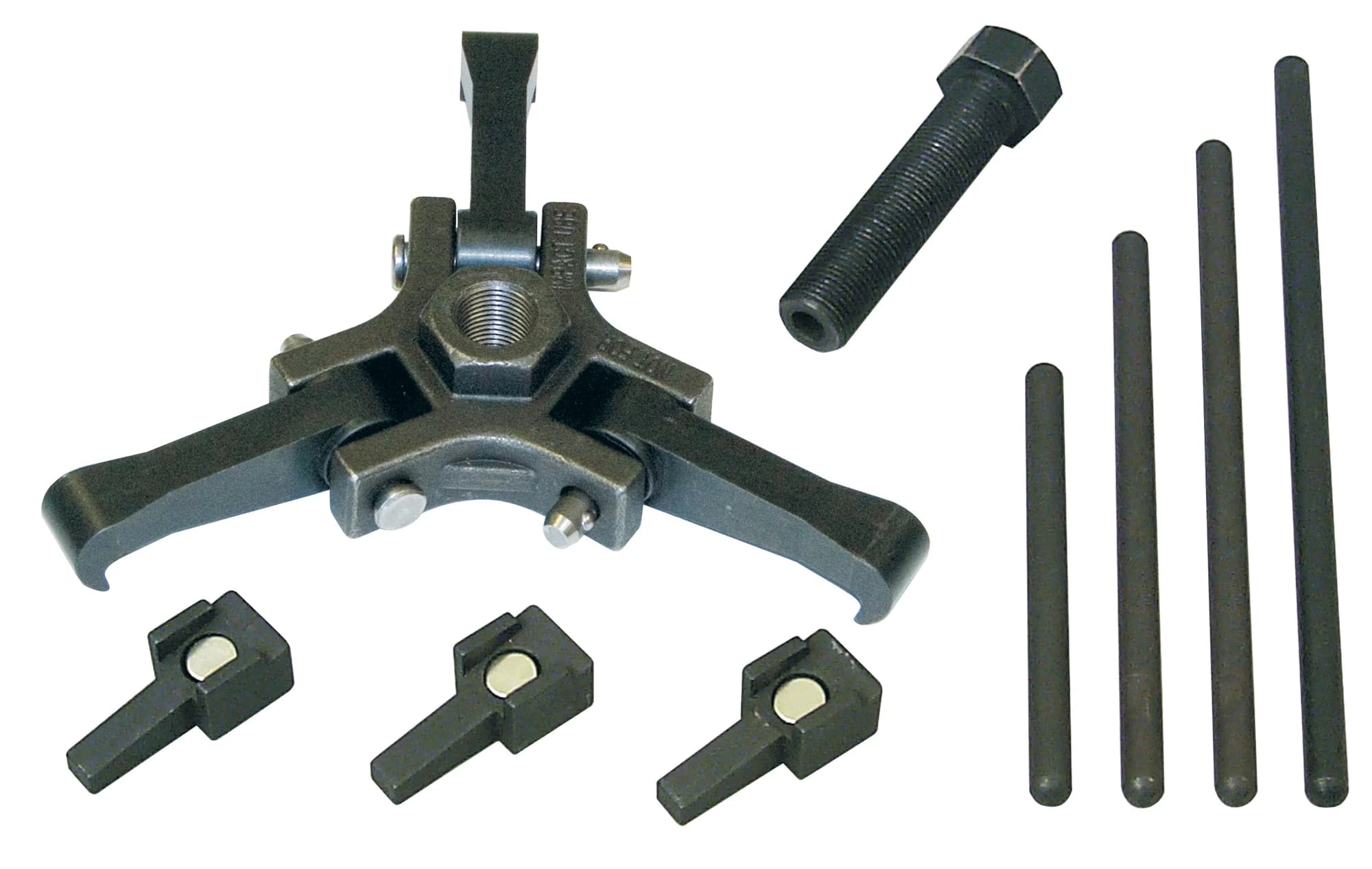
Mechanical tool, not a diagnostic instrument
The Lisle 51450 is a physical removal tool for harmonic dampers and pulleys. Lisle describes it as a low-profile puller and explicitly distinguishes its job from a gauge or electronic diagnostic device. That matters because the tool should be selected from the engine and damper pattern first, not from a generic “harmonic balancer” search term. The page names Chrysler, GM, GM LS, Mitsubishi and Dodge, then adds specific engine and year examples. Those are the boundaries this review can support; no universal-application claim is warranted.
Low-profile access is the design thesis
Lisle says the low-profile design works in confined spaces and can eliminate the need to remove the radiator. That is the product’s most consequential workflow advantage: less front-end disassembly can matter when the damper is accessible but surrounding clearance is limited. The page does not provide a dimensional drawing or minimum clearance figure, so the benefit should be read as an intended application characteristic rather than a promise for every vehicle. Confirm access around the specific damper and puller frame before committing to the job.
What changed from the predecessor
The 51450 is described as updated and superseding 49500. Lisle identifies new jaw geometry, slimmer magnetic spacers and a fourth rod. The new geometry and spacer profile are aimed at fit and retention, while the fourth rod is what enables the additional listed applications, including 4.2L GM crossovers, Colorado/Canyon engines, Hummer H3 and GM LS. Those details make this more than a cosmetic refresh. They also make the included configuration important: substituting a different rod or jaw arrangement could change fitment.
Jaws, rods and serviceability
Lisle says the jaws are held in place with a clevis pin and can be removed and replaced easily. The page lists replacement components individually: clevis pin 49520, frame body 49540, jaw 51640, magnetic jaw spacer/housing 51670, drive screw 49590, and rods in 4-, 5-3/8-, 6-1/2- and 7-3/8-inch lengths. That parts-level detail is a real ownership advantage because it makes the tool’s wear components identifiable. The page does not state a torque limit or maintenance interval, so lubrication and service practices remain unresolved.
Application examples are not a universal chart
The named examples include 5.9L Dodge, 4.2L Trailblazer/Envoy/Bravada, 4.2L Buick Rainier, 3.5L and 2.8L Colorado/Canyon, Hummer H3 and GM LS engines, with some model-year qualifiers. This is useful evidence for selection, but it is not permission to infer every engine from the same brand or displacement. For example, the fact that GM LS is listed does not establish coverage for every GM crank or damper arrangement. Treat the exact engine, year and damper attachment as the fitment check.
Ownership, feedback and decision
Lisle lists a 2.6-pound shipping weight and shows individual replacement parts. The page also carries one customer review from Larry Hendrickson, who called it “Well made tool.” That short remark is a user opinion, not a controlled test, and the same review describes a difficult Mitsubishi Eclipse removal; it should not be generalized to every job. Overall, the 51450 is a compelling application-specific solution when its low profile and listed jaw/rod set match, but a poor substitute for a broad master puller set.