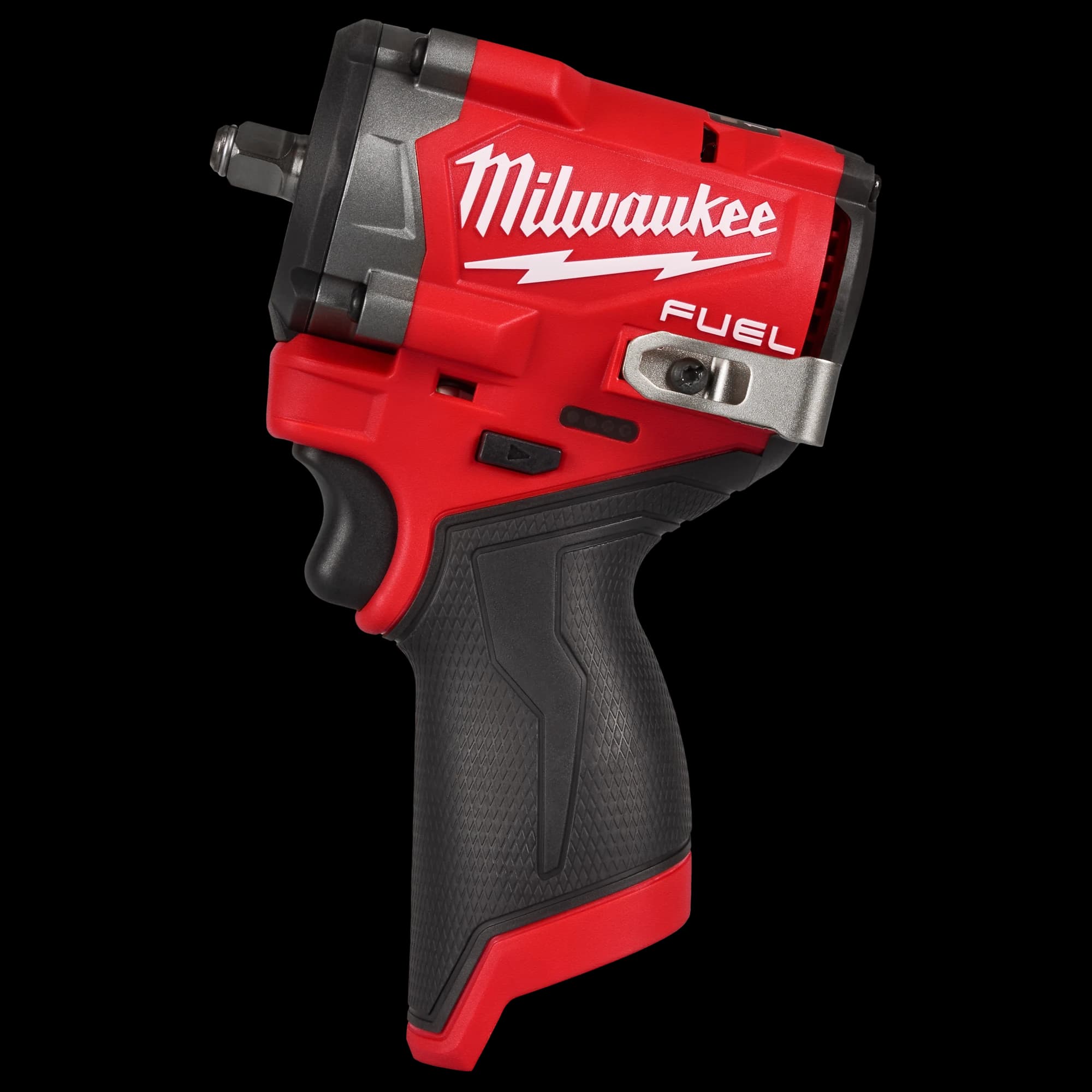
Compact power profile
Milwaukee positions the 2562-20 as a new 3/8-inch Stubby impact using a POWERSTATE brushless motor. The published headline figures are up to 550 ft-lb of nut-busting torque, 0–3,000 RPM in Mode 3 and a 2.2-pound bare-tool weight. That combination makes the model’s identity clear: it prioritizes access and reduced fatigue while retaining enough removal capability for stubborn automotive fasteners. “Up to” is the manufacturer’s maximum claim, not a guarantee for every battery, socket, joint or operating condition.
Four-mode output control
The four-mode DRIVE CONTROL system gives the user four published speed bands: Mode 1 reaches 930 RPM, Mode 2 2,100 RPM, Mode 3 3,000 RPM and Mode 4 1,300 RPM. Impact rates are listed as 1,500, 3,000, 3,300 and 3,300 IPM respectively. Milwaukee also documents forward AUTO-SHUTOFF that applies no more than 15 ft-lb for hand-tight applications, plus reverse bolt-removal mode that slows after the bolt frees. These are control behaviors, not a calibrated final-torque measurement.
Access, lighting and handling
The stubby format is intended to fit where larger impacts cannot without extra accessories or disassembly, according to the product page. Tri-LED work lights illuminate the workspace with fewer shadows, and modes can be changed one-handed by placing the shuttle in neutral and double-tapping the trigger. The new battery isolation system is described as securing the pack and reducing vibration transmitted to it. Those features target a technician moving frequently between fasteners, although the page does not provide overall length or head dimensions for a numerical access comparison.
Battery-system fit
The 2562-20 is compatible with all M12 REDLITHIUM batteries and chargers, so its strongest ownership case is for a shop already invested in that system. The page labels it as a bare tool and points to a manual/parts list, but does not list a battery or charger in the product contents shown. That distinction matters when comparing a tool-only purchase with a kit. Battery choice can also affect balance and runtime, yet the fetched product page does not publish a runtime figure or loaded weight.
Fastener work and limits
A 3/8-inch friction-ring socket retention system is specified, reducing downtime when accessories are changed frequently. For automotive work, that points toward brake, suspension, underbody and engine-bay tasks where access is more valuable than a large drive. In contrast, the listed DEWALT DCF900B is a 1/2-inch high-torque model with a higher published breakaway claim, so the two occupy different tool roles rather than a simple winner-loser comparison. Use impact-rated sockets and do not treat auto-shutoff as proof of final fastener torque.
Ownership decision
The 2562-20 is a strong fit when compactness, low bare-tool weight and the M12 ecosystem are decision drivers. Milwaukee lists a brushless motor, battery isolation, lighting, friction-ring retention and four modes, giving the model a feature set tailored to repeated service work. Its boundaries remain important: bare tool, 3/8-inch drive, no published overall dimensions in the fetched page and no documented calibrated torque output. Select it for access and controlled impact behavior, not because a maximum nut-busting number makes it universal.