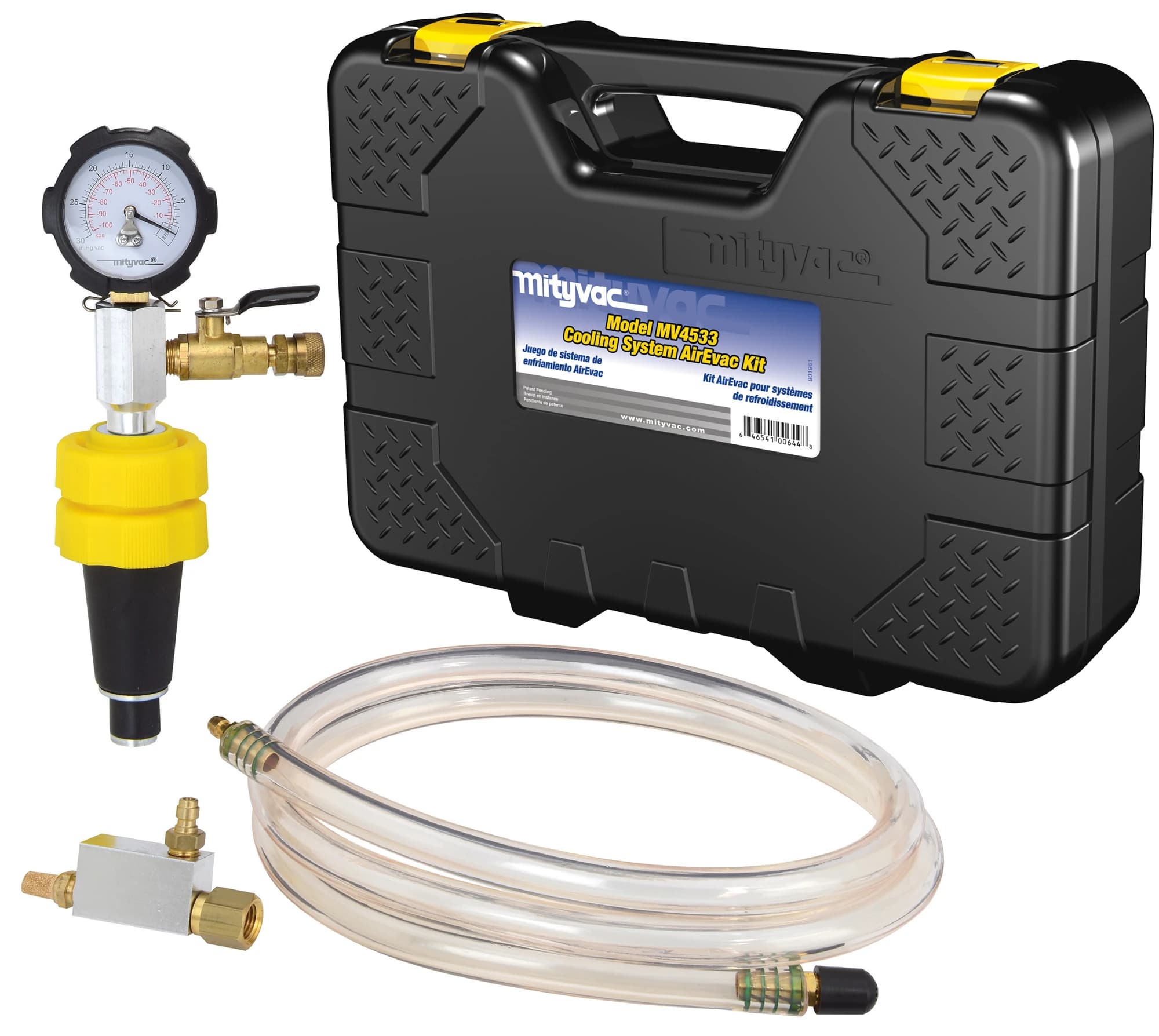
What the MV4533 actually does
The MV4533 combines an expandable rubber adapter, vacuum pump assembly, coolant hose assembly, flow control, and vacuum gauge into a refill sequence. The manual first has the operator drain the cooling system, seal the filler neck, attach the vacuum assembly, and connect shop air. After the vacuum hold, coolant is drawn from a separate supply through the hose. That is a different job from simply applying pressure to look for a leak: the documented centerpiece is evacuation, stability checking, and controlled refill.
The vacuum-hold step is its diagnostic value
Mityvac specifies an approximate vacuum level of 23 inches of mercury. Once that level is reached, the flow-control valve is closed, the air supply and pump are disconnected, and the gauge needle is watched. The instructions say that if there is no change for 30 seconds, the system is ready to be refilled. This gives the operator a practical hold check before coolant is introduced, although the manual does not call it a quantified leak-rate test or promise that every vehicle can be serviced with this setup.
Adapter setup demands attention
The expandable plug is inserted into the radiator or expansion-tank filler neck after residue is wiped away. The manual warns that coolant can act as a lubricant and allow the adapter to slip during pressure testing; it also recommends slowly pulling up on the adapter to confirm that it holds, then adjusting the tension knobs if needed. That makes cleanliness and fit central to the tool’s performance. The same instructions caution against over-tightening plastic radiator or expansion tanks, so “universal” fit should not be assumed from the manual alone.
Compressed-air and refill workflow
The refill sequence is straightforward but not self-contained: shop air is connected to an air connector at the vacuum pump, the valve is opened, and the gauge is monitored. The manual explicitly marks that connector as not included. After the hold, the coolant hose is connected to the adapter and its free end is submerged in a coolant supply. When the gauge reaches zero, the system is considered full; the engine is then brought to operating temperature and the level is topped off as required.
Ownership and serviceability
The manual names the vacuum pump assembly as service part 801957, the coolant hose assembly as 823485, and the vacuum gauge as MVA6172. It says the cooling-system adapter is not available as a service part. That is useful ownership information: common assemblies are identified, but damage to the adapter may not be addressed with an individually listed replacement. The instructions also direct users to general sales conditions for warranty information rather than stating warranty terms in the manual, so buyers should not infer coverage details from this document.
Where it fits in a cooling-system toolkit
The MV4533 makes the most sense where a shop regularly drains and refills cooling systems and wants a repeatable vacuum procedure. It is less compelling for a one-off inspection that only needs pressure-side leak checking, because this manual emphasizes refill rather than a pressure-test range. Mityvac also says cooling systems differ and that some documented tests may not be possible on every vehicle. The right conclusion is capability-specific: this is a vacuum evacuation/refill workflow with a hold check, not a promise of all-vehicle service.