What the system does
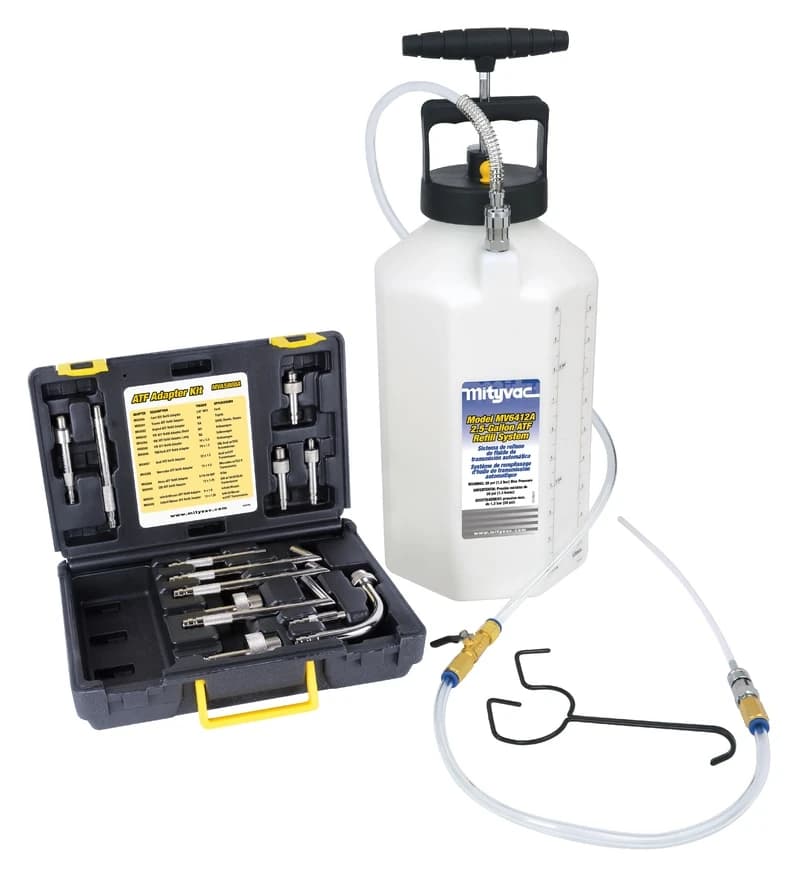
The MV6412A is a pressurized ATF refill system, not an evacuator. Mityvac says it is intended to fill or top off today’s sealed automatic transmissions, with the reservoir’s pressure providing a smooth, continual flow instead of continual hand pumping. That makes the tool’s value dependent on a correct transmission-level procedure and the right adapter, not simply on its ability to move fluid. The catalog names it as a complete system with the MVA5800A adapter kit, so the model-specific story is about controlled refill coverage rather than generic fluid transfer.
Reservoir, pressure, and controls
The supplied catalog lists a 2.5-gallon (10-liter) reservoir, 20 psi (1.4 bar) maximum pressure, 8-pound (3.6-kilogram) packaged weight, and 8.5-by-12.3-by-22.2-inch dimensions. It also specifies a five-foot dispensing hose with flow-control hardware, an integrated manual pump, pressure gauge, and pressure-relief valve. These details point to a self-contained, manual-pressure workflow. They do not establish a vehicle-specific fill pressure or authorize pressurizing a transmission beyond its service procedure; those decisions remain vehicle-manual matters.
Adapter coverage
Mityvac lists thirteen adapters, MVA580 through MVA592, in the MVA5800A kit and names Ford, Toyota, BMW, Honda, Nissan, Volkswagen, Audi, Mercedes, and Volvo transmissions among the supported connection families. That is useful breadth, but it is not blanket compatibility for every year, transmission, or fill port from those brands. The catalog’s wording supports adapter-family coverage, while the actual fit still depends on the transmission’s service connection. A careful buyer should match the supplied adapter chart to the exact transmission before treating the system as a sealed-unit solution.
Aeration and dispensing design
The catalog says the integrated manual pump adds air above the fluid level to prevent aeration, while internal pump components are sealed against exposure to fluids. It also places the on/off and flow-control valve near the output and uses push-to-connect, quick-change accessory connections. Those are meaningful workflow features: the operator can meter a steady stream and change the connection without rebuilding the entire fluid path. They do not substitute for confirming fluid specification, cleanliness, level-check temperature, or the manufacturer’s required fill sequence for the transmission being serviced.
Best workshop role
This is a strong fit for a shop that regularly services sealed transmissions and wants one refill setup with organized adapters, a gauge, and a larger reservoir. The five-foot hose and output controls are especially relevant when the fill point is awkward, although the source does not describe hose flexibility under load or the precise wand geometry beyond listing a fluid dispensing wand. It is less compelling for a one-off conventional drain-and-fill where a simple hand pump is adequate. The catalog supports repeated refill convenience, not a claim of faster service.
Refilling is different from evacuation
The MV7300 elsewhere in this catalogue uses shop air to draw compatible fluids out, while the MV6412A pressurizes a clean reservoir to dispense ATF into a supported transmission connection. They answer opposite fluid-handling needs and should not be treated as versions of the same pump. The MV6412A's integrated manual pump pressurizes the air space above the fluid; the current manufacturer page does not require a compressor for that operation. Choose it when the transmission's connection, fluid specification and level-check procedure justify a dedicated refill system, rather than buying an extractor and expecting it to fill.