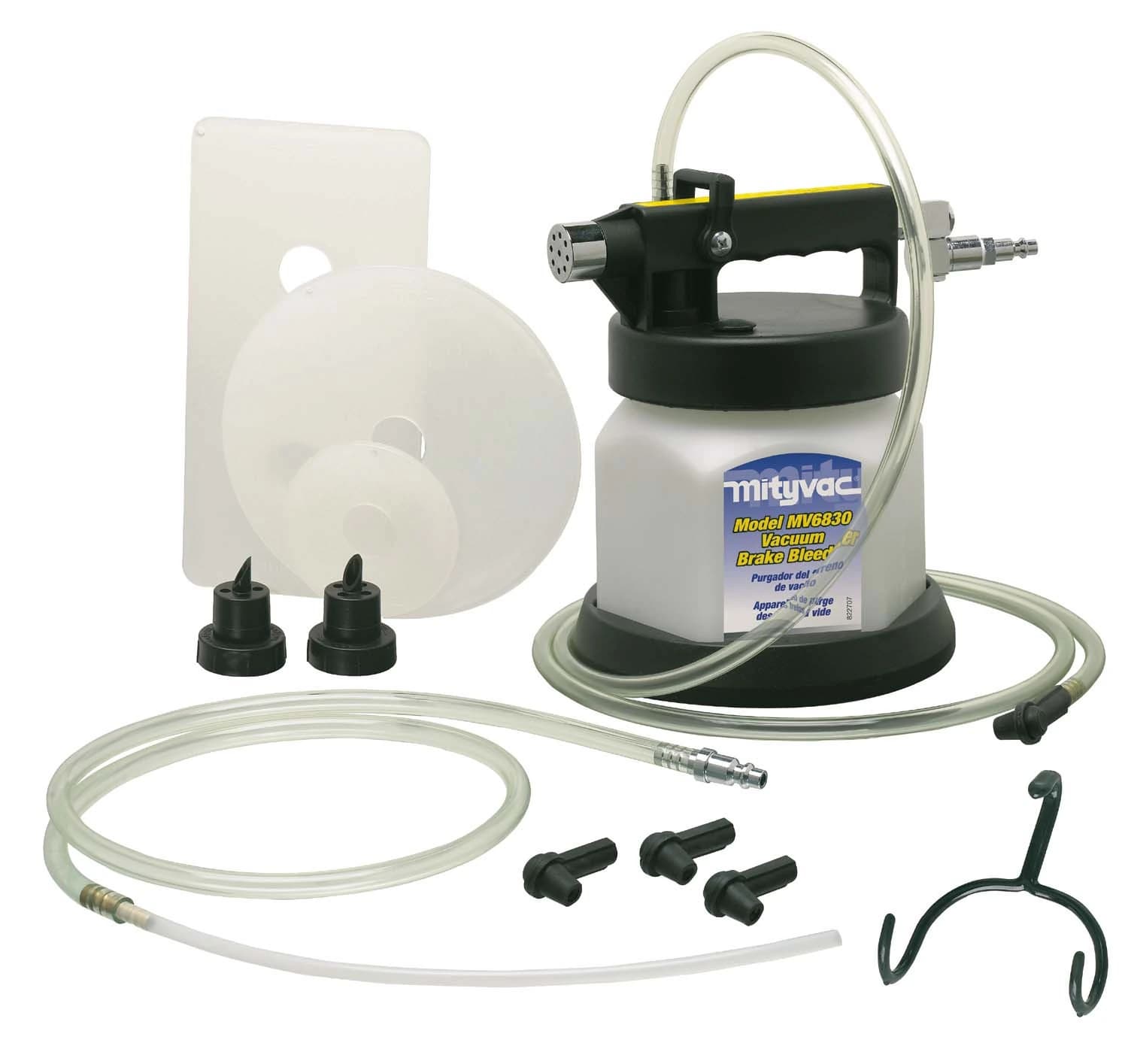
Pneumatic operating concept
The MV6830 creates vacuum from compressed shop air rather than from an electric motor or hand pump. Mityvac describes the Venturi arrangement as suitable for brake bleeding, hydraulic-clutch bleeding, and evacuating fluid from tanks or reservoirs. That makes the model a workflow tool for service bays with air already available. The operating window is explicitly 60–150 psi, so the air system is part of the purchase decision. A user with no compressor should not read its portable form as cordless capability; the unit is portable around a shop, but pneumatic in operation.
Control, vacuum, and throughput
The model pairs a variable thumb-operated throttle with published performance at defined air pressures. At 90 psi, the brochure states 26 in. Hg vacuum and 4.3 cfm air consumption; flow is listed as 50 oz/min at 60 psi and 70 oz/min at both 90 and 150 psi. Those figures make the throttle more meaningful than a simple on/off trigger: the operator can moderate the process while preserving a useful reserve. They should still be treated as bench-level specifications, because hose routing, fluid condition, bleeder design, and vehicle hydraulics affect actual service time.
Reservoir and included fluid management
The 1.9-quart removable reservoir is the MV6830’s practical center of gravity. It is large enough for the brochure’s stated brake-bleeding workflow and removes for emptying, while an automatic shutoff is intended to prevent overfill. Mityvac also lists a refill kit for maintaining new fluid in the master cylinder or clutch reservoir during bleeding. The standard accessories include a bleed hose with universal adapter, an evacuation wand, three spare universal bleed-screw adapters, a quick-change nipple, and a hanging hook. This is a more complete fluid-handling package than a bare vacuum generator.
Shop layout and ownership
Small details shape whether this pneumatic tool stays convenient. The swivel air inlet with quick-disconnect nipple is intended to reduce hose fighting, the formed handle supports repositioning, and the molded base can be bench mounted with screws. The noise-reducing muffler is a useful ownership detail, but the brochure does not quantify sound output. The large coarse threads are described as reducing cross-threading, not as making incorrect connections safe. Keep the unit, hoses, and adapters clean, inspect seals and connections, and use only the published pressure range rather than treating maximum pressure as a required setting.
Best-fit service and boundaries
MV6830 makes the most sense where repeat fluid service matters more than ultimate portability. Its ability to evacuate reservoirs gives it a second job beyond bleeding, and the refill arrangement can help maintain fluid level during a properly controlled procedure. It is not presented as a pressure bleeder, diagnostic instrument, or universal adapter system for every vehicle. The brochure’s universal language describes included accessories, not guaranteed compatibility with every bleeder screw. Before a job, confirm the adapter fit and vehicle procedure; after it, verify the hydraulic system independently rather than assuming vacuum flow proves a successful bleed.