What this model is
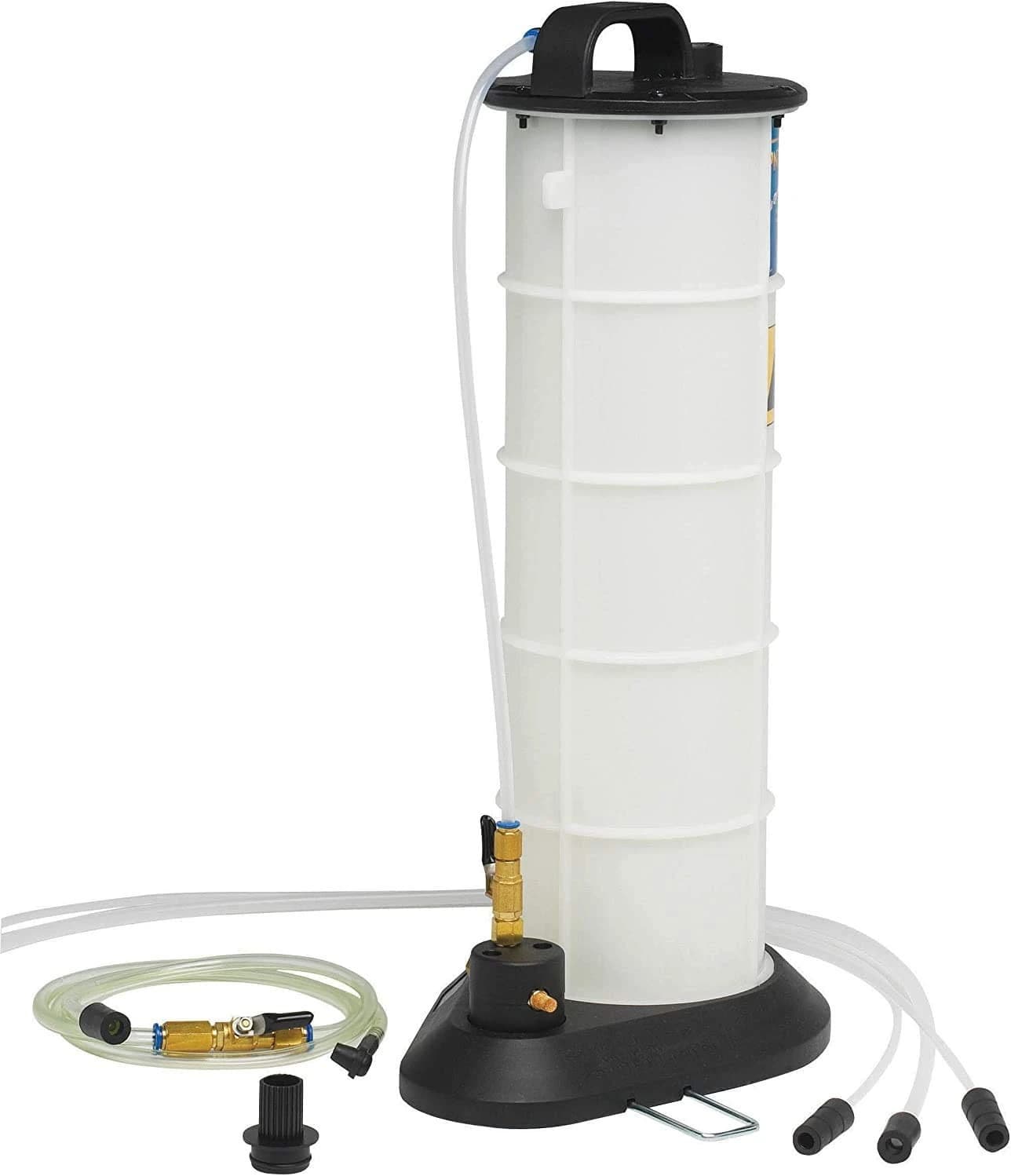
The MV7300 is the larger of the catalog’s two plainly named Mityvac fluid evacuators, built around a reservoir rather than a hand-pump-only bottle. Its job is removal: Mityvac describes it for evacuating fluid from virtually any reservoir or tank, including oil, lubricants, hydraulic fluids, and coolant-related service. The key distinction is its pneumatic approach. Standard shop air drives a venturi vacuum, so the operator does not repeatedly pump a handle while fluid is drawn out. That makes this a service-bay tool, not merely a compact emergency extractor.
Capacity and footprint
The catalog specifies a 2.3-gallon (8.8-liter) capacity, 7.5-pound (3.4-kilogram) weight, and a 25.6-by-13-by-9.5-inch tall-by-wide-by-deep size. That is enough room for a meaningful fluid-change workflow while remaining portable on paper. The dimensions also explain the tradeoff: it is a tall, wide-footprint reservoir that needs a stable parking spot and careful hose management. The published figures are catalog/package-style specifications; they do not establish usable fill volume under every fluid, tube, or vehicle condition.
Air-powered workflow
The venturi principle is the MV7300’s reason to exist. Once connected to standard compressed shop air, it creates vacuum without electrical power or manual effort, according to the catalog. That favors repeated oil or fluid evacuation in a garage with a compressor and makes it less appealing for roadside work. The source does not state a required inlet pressure, air consumption, hose length, included tube set, or a maximum fluid temperature. Those omissions matter when planning an installation, so treat air-supply compatibility and the exact package contents as unresolved until the manual or seller package is checked.
Where it fits best
Mityvac positions the family for draining or changing fluids in motorized equipment, and the MV7300 is the high-capacity pneumatic member shown in the supplied catalog. It therefore suits a workshop that wants dipstick-tube or reservoir evacuation without opening a drain plug, provided the vehicle and fluid are suitable for extraction. It is not a diagnostic instrument, a pressure dispenser, or an all-purpose waste-oil cart. The reviewable evidence supports evacuation use broadly, but not a promise that every reservoir, fluid viscosity, or access tube will evacuate completely.
Ownership and maintenance
The published material emphasizes durable, portable fluid-equipment design but does not give a maintenance schedule, replacement-parts list, fluid compatibility chart, filter arrangement, or cleaning procedure specifically for MV7300. In practical ownership terms, the reservoir and suction path should be kept segregated by fluid type, and the operator should confirm how the product is emptied and cleaned before switching between coolant, oil, and hydraulic fluids. Those are sensible workshop controls, not claims of a supplied feature. The missing care instructions are a reason to retain the manual with the unit rather than rely on the catalog alone.
How it compares within Mityvac
The same catalog places the manually operated MV7400 beside MV7300 and identifies the MV7201 as a 2.3-gallon evacuator-plus model that can evacuate or dispense without electricity or compressed air. That comparison clarifies the purchase decision: MV7300 prioritizes shop-air-powered, no-manual-effort evacuation; MV7400 prioritizes independence from shop air at lower stated capacity; MV7201 adds dispensing functionality. The comparison does not prove speed, suction strength, or durability differences. Choose on the workflow actually available, not on an assumed performance ranking.