The nine-way premise
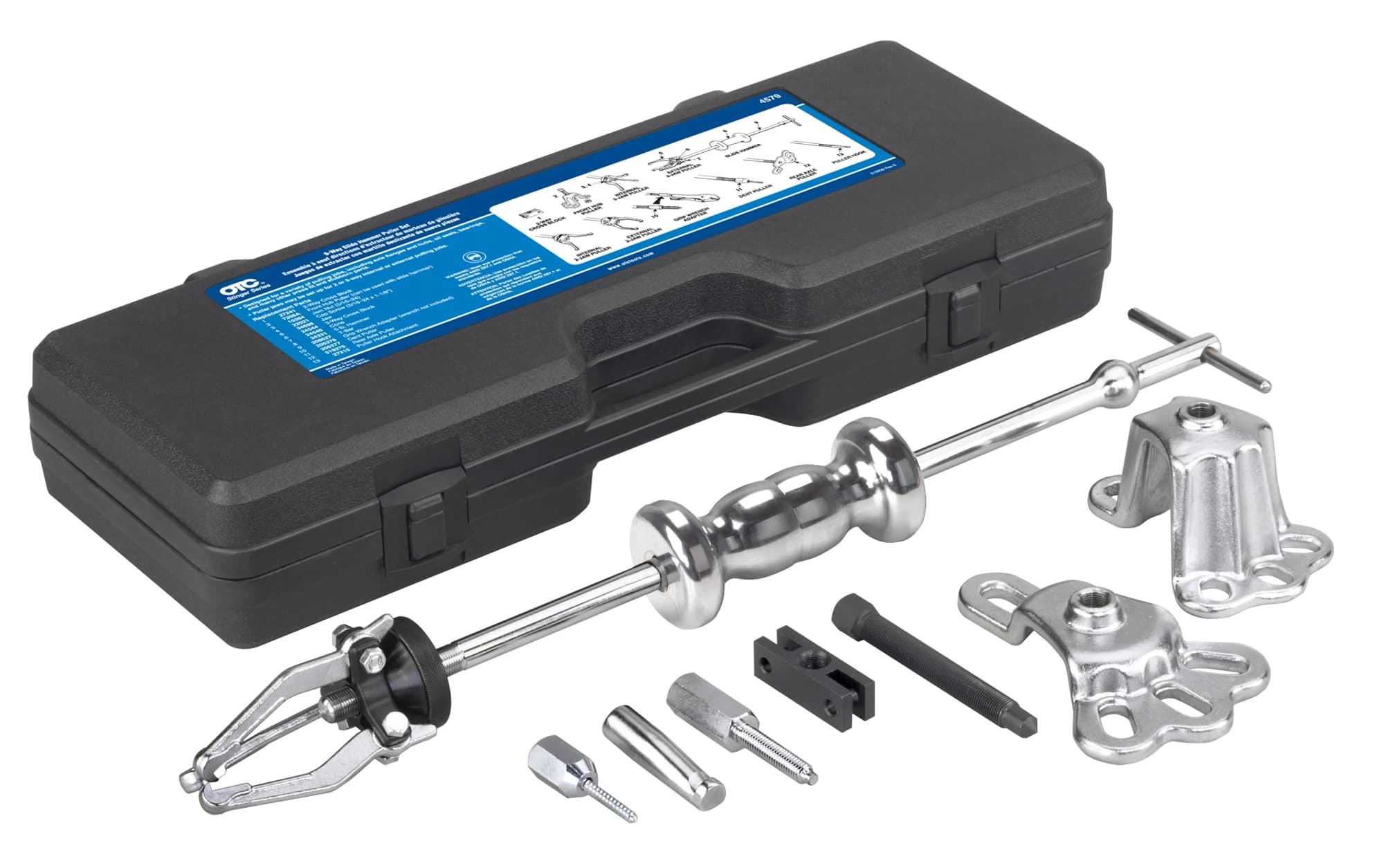
OTC builds the 4579 around a 5-pound polished-chrome slide hammer and a set of attachment geometries rather than one fixed puller. Internal and external jaws, two- and three-way cross blocks, and a cone let the operator configure the tool for different pulling directions and component shapes. This is why the set reaches beyond hubs: OTC also names bearings, gears, and seals. Versatility is useful only when the jaws contact strong, intended surfaces. A slide hammer’s movement is a method choice, not a universal answer for every pressed or seized component.
Hub and axle work
The product description specifically calls out flange-type rear axles and most front-wheel-drive hubs. The included list names a front hub puller and a rear axle puller, giving those tasks dedicated arrangements within the kit. “Most” is an important qualifier: hub designs and access vary, so the source does not justify a blanket compatibility claim. Before pulling, confirm that the attachment bears on the correct flange or hub features and that the axle or bearing assembly can tolerate the chosen load path. The kit expands options; it does not replace application judgment.
Beyond hubs
Internal and external three-jaw and two-jaw pullers make the 4579 relevant to bearings, gears, and seals, while the grip-wrench adapter and dent-puller attachment extend the set into less conventional work. The dent attachment is identified for sheet metal or other unique pulling requirements, so bodywork is part of the manufacturer’s stated scope. These accessories are not interchangeable in purpose: a seal extraction setup and a sheet-metal dent setup need different contact strategies. Keep the attachment aligned, avoid unsupported thin material, and choose a configuration that distributes load rather than concentrating it on an edge.
Compatibility and storage
OTC states that the set is designed for use with other 5/8-inch–18 thread slide-hammer attachments. That thread standard improves expandability within the compatible accessory family, but it does not prove that every third-party attachment is safe or mechanically suitable. The kit arrives in a blow-molded case, and the page lists 24 × 9.5 × 4.5-inch product dimensions and 17.2-pound product and shipping weights. The case is therefore part of a fairly substantial shop kit, not a minimal glovebox accessory. Inventory the attachments before a mobile job.
Safety and task selection
OTC links dedicated puller safety information from the product page, a useful signal that setup and load management are part of ownership. This tool is most compelling when impact extraction is faster than building a press setup and the component has a sound pulling surface. It is less suitable when the job demands a controlled, non-impact press or the hub/axle does not support the attachment. Do not equate nine configurations with nine guaranteed applications. Select the smallest effective arrangement, keep observers clear, and follow the linked safety guidance.