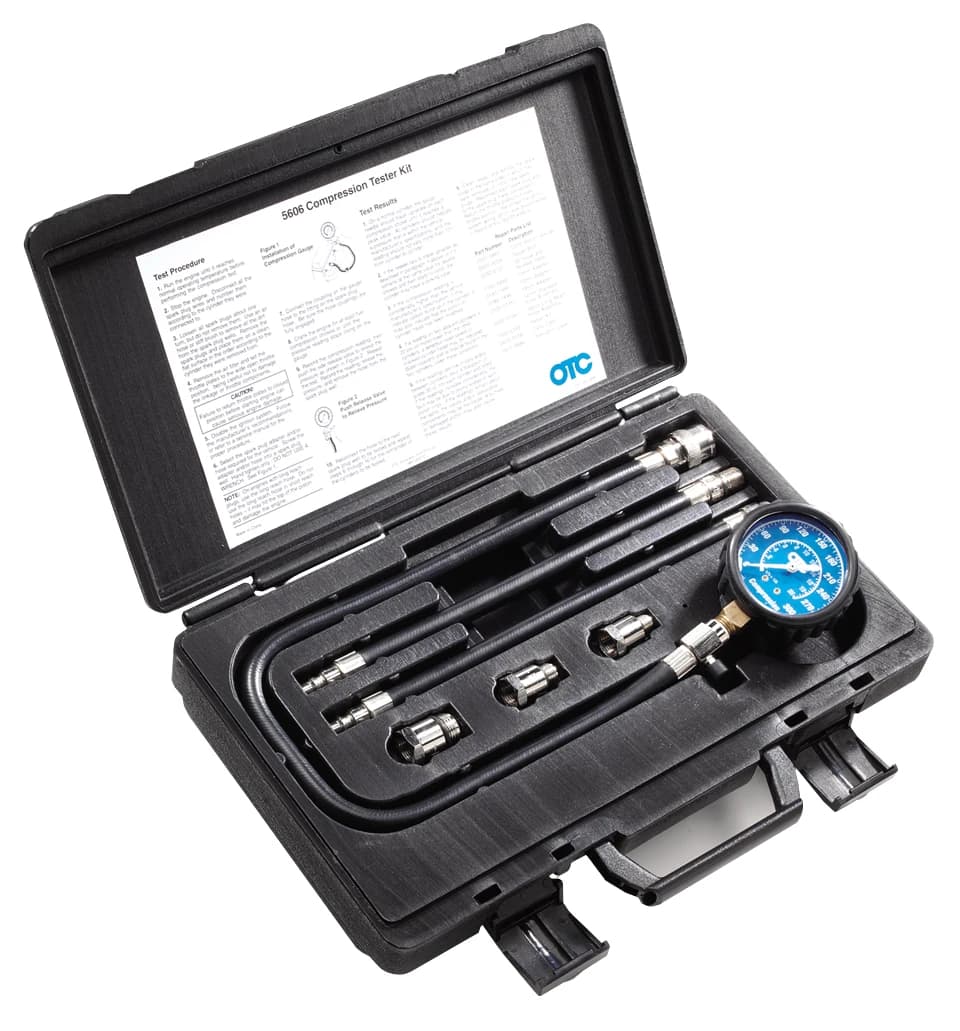
Gasoline scope and diagnostic role
OTC designs the 5606 for complete compression testing on gasoline engines, including domestic, import, motorcycle, marine, and small engines. That breadth is about engine categories, not a promise that every plug thread or access geometry is covered. The tool is for measuring cylinder compression through a spark-plug opening; the supplied page does not describe a diesel adapter or high-pressure diesel procedure. That boundary is important because a compression kit should be matched to the engine type before the gauge or hose is connected.
Gauge, hose, and readability
The kit uses a professional-quality gauge with a zero-adjust feature and a 2-1/2-inch face with chrome bezel and protective outer boot. OTC publishes a dual scale of 0–300 psi and 0–2100 kPa. The 26-inch flexible hose assembly has a quick coupler, and OTC says the extra length allows viewing outside a cluttered engine compartment. These are usability features that address access and reading position. The page does not state accuracy, repeatability, pressure-hold time, or a calibration interval.
Adapter coverage is the buying decision
OTC includes 10 mm, 12 mm, and 18 mm thread adapters, plus 12-inch flexible 14 mm standard-reach and long-reach adapters. The page says the adapters work on both flat and tapered seat plugs. That is a strong fit-oriented specification for varied gasoline engines, especially motorcycles and small engines where plug size and access can differ. It still is not universal coverage: the source does not list other thread sizes, sealing materials, or a vehicle-by-vehicle chart. Confirm the target engine before relying on the kit.
Case and serviceability
A rugged blow-molded hard case with removable lid is included, along with a repair parts kit. OTC also lists product dimensions of 14.9 by 9.5 by 3.4 inches and shipping weight of 3.8 pounds. Those details support organized storage for the hose and adapters, although the source does not itemize the repair kit or identify individual replacement parts. The case is a practical ownership feature, but this review does not convert it into a claim about drop resistance or field durability beyond OTC’s wording.
How to interpret what it measures
The 5606 gives a technician a pressure reading for a gasoline-engine compression check, but the page does not supply an interpretation chart or a pass/fail threshold. That means the tool should be used as part of an engine-specific diagnostic procedure rather than as an automatic verdict. A zero-adjust gauge and dual scale make repeated readings easier to read, while the hose and adapter coverage improve access. They do not establish compression accuracy or diagnose the cause of a low reading on their own.
Best shop fit and clear exclusions
This kit fits a general repair shop, motorcycle service area, or enthusiast who needs one cased set for multiple gasoline-engine families and plug reaches. Compared with OTC’s 7991, it targets cylinder compression rather than cooling-system pressure testing. Compared with the Mityvac MV4533, it has no documented vacuum-refill function. The model should be skipped for diesel work or engines outside the listed thread/reach set unless separate verified equipment is added. Its strongest case is breadth within gasoline applications, not all-engine universality.