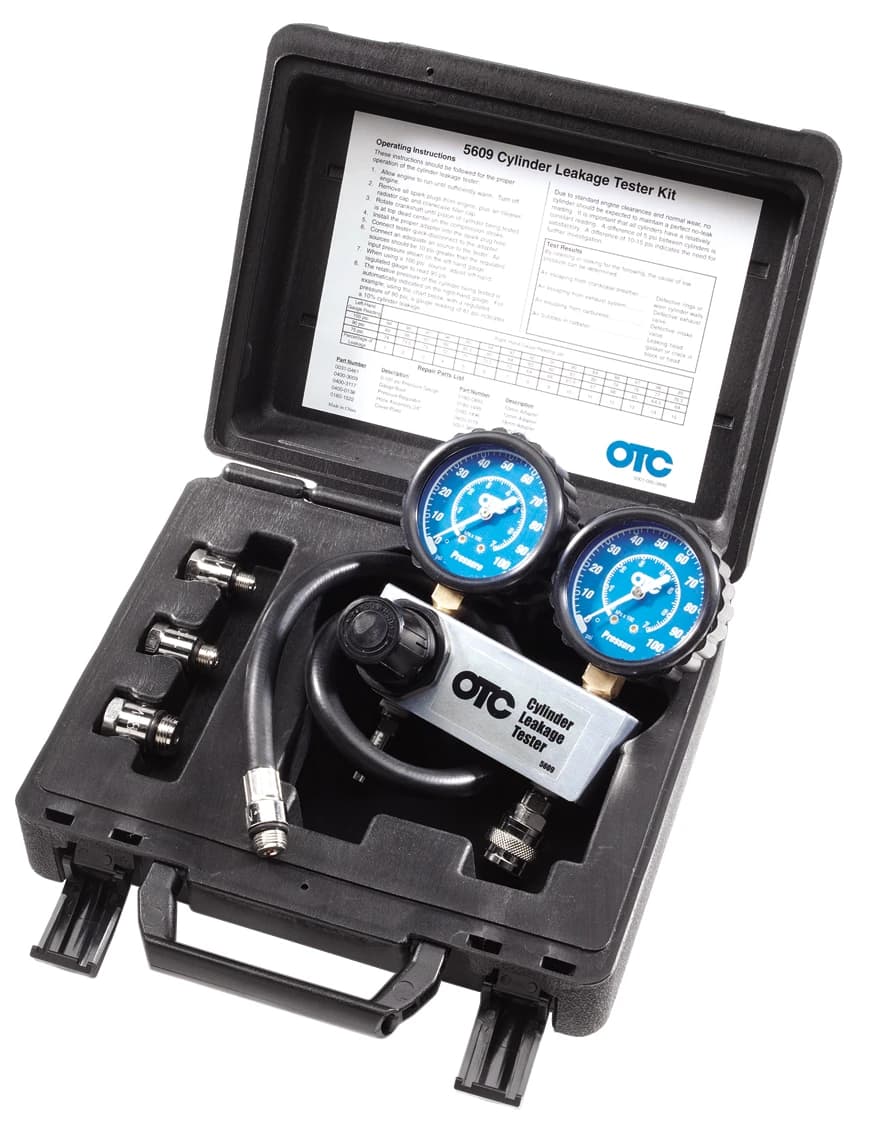
What the 5609 actually measures
The OTC 5609 is designed around cylinder leakage diagnosis. OTC says it can help identify bad rings, valves and leaking head gaskets, so its value is in following escaping pressure to an internal-engine fault rather than merely recording cranking compression. That distinction matters in a workshop: a compression number can show a symptom, while a leakage setup is intended to help investigate the path. The page does not promise a universal engine fit; it says the kit comes with adapters for most applications, so the supplied threads should be checked against the engine before disassembly.
Gauge and manifold layout
The kit uses dual 2-1/2-inch gauges with chrome bezels and protective outer boots. Both gauges read 0–100 psi and 0–700 kPa, providing a straightforward metric/imperial pairing for the same test. OTC also specifies a pressure-regulated manifold and quick couplers. That combination is more useful than a bare gauge because the manifold provides the control point and the couplers make the hose connection repeatable. The page gives no accuracy, tolerance or calibration claim, so this review treats the scales as published readout ranges, not as a verified laboratory specification.
Adapters and access
OTC supplies 10 mm, 12 mm and 18 mm thread adapters, along with a 24-inch flexible 14 mm hose. The hose length should help when the gauge needs to sit away from a crowded plug well, while the three adapters cover the manufacturer’s stated most-applications positioning without proving universal compatibility. The page’s own “14 mm hose” wording and separate adapter sizes should not be conflated: the hose designation is not a promise that every engine’s plug thread is 14 mm. Confirm thread, reach and sealing arrangement before applying air.
Ownership and storage
The 5609 includes a blow-molded hard case with removable lid and a detailed instruction chart. Those are practical ownership features for a kit containing small adapters and quick-coupler pieces: keeping the set together reduces the chance of starting a diagnosis with a missing thread piece. OTC lists product dimensions of 10.25 × 8.75 × 3.8 inches and a 4-pound shipping weight. The page does not identify replacement seals, spare hoses or a service interval, so long-term maintenance details remain an open question rather than a reason to infer durability.
Where it fits in a diagnostic drawer
Among the three OTC products reviewed here, the 5609 is the internal-engine leak specialist. The 5613 is described for vacuum lines, components and low-pressure fuel systems, while the 5630 targets fuel filters, regulators, lines and pumps. That makes the 5609 the wrong first choice for a fuel-pressure complaint even though its gauges also show psi. Conversely, a vacuum gauge cannot replace a cylinder leakage setup. Choosing by diagnostic path—not by the presence of a familiar pressure scale—prevents an expensive mismatch.
Shop-use limits and buying decision
A careful buyer should treat the 5609 as a complete-looking hardware kit whose published scope is narrower than “engine diagnosis” in general. OTC documents the gauges, manifold, hose, adapters, case and chart, but not an accuracy class, maximum input-air pressure, test procedure details or exact engine coverage. That is not evidence of a defect; it is a documentation gap. It is a sensible selection when the repair workflow already has a regulated air source and the adapter threads are known. It is a poor choice when those prerequisites are unknown.