Two diagnostic jobs, one face
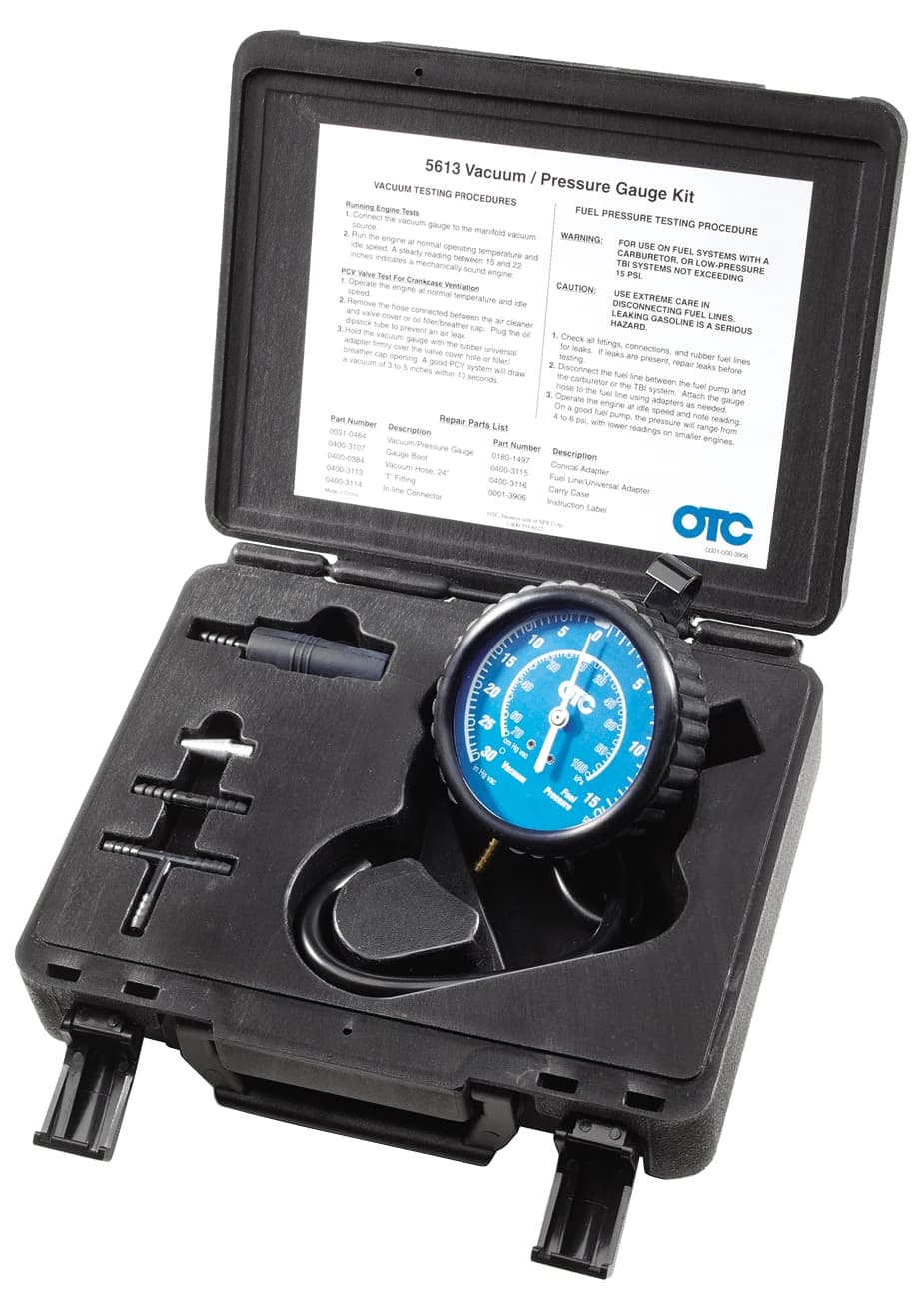
OTC positions the 5613 for testing vacuum lines and components and for accurately testing low-pressure fuel systems. It also says the kit can help diagnose bad rings, valves and leaking head gaskets and pinpoint cracked lines. The useful editorial takeaway is breadth within traditional engine diagnosis: the same analog instrument can observe manifold-style vacuum behavior and low fuel pressure. That breadth has boundaries. The published description says low-pressure fuel systems, not every fuel-injection architecture, so the gauge should be matched to the system’s specified test range before connection.
Readable dual scales
The 3-1/2-inch gauge reads 0–30 in. Hg vacuum and 0–70 cm Hg, plus 0–15 psi and 0–100 kPa pressure. The paired scales are the 5613’s central advantage over a single-reading instrument: a technician can work from specifications written in either unit system without converting at the bench. OTC calls it a dual-purpose gauge rather than a digital meter, and the page provides no accuracy tolerance, damping behavior or calibration interval. Those omissions matter for trend diagnosis, so treat the scale as a practical indication, not a certified measurement claim.
Access and protection
OTC specifies a chrome bezel and rugged protective outer boot around the large gauge. That combination is tailored to a tool likely to be moved between engine bays and test points, where the face needs protection and the pointer needs to remain visible. The page says the kit includes an adapter for most applications, but does not list its thread or hose arrangement. That makes the instrument’s headline versatility conditional: verify the connection before planning a test, especially where a vehicle uses an unusual port or a tight access route.
Case and footprint
The 5613 is supplied in a blow-molded hard case with removable lid according to the manufacturer’s feature list, and OTC lists product dimensions of 10.3 × 8.9 × 3.9 inches with a 2.5-pound shipping weight. The case is a good fit for a mobile diagnostic drawer because it gives the gauge and accessory a defined home. The page does not list replacement hose parts, spare adapters or a maintenance schedule. Owners should therefore preserve the adapter and protect the gauge rather than assume a fully documented service ecosystem.
How it differs from the neighboring OTC kits
The 5613 should not be selected merely because it shows psi. The OTC 5609 is a cylinder leakage kit with dual 0–100 psi gauges, regulated manifold and three listed thread adapters. The 5630 is a fuel-pressure tester with a 0–100 psi scale, brass fittings and pressure-relief valve. The 5613 instead combines vacuum and low pressure on one 0–15 psi pressure scale. Those distinctions make it the most natural of the three for vacuum-first diagnosis, not the broadest answer to all fuel problems.
Who should pass
Pass on the 5613 when the work order calls for a published high-pressure range, digital capture or a confirmed adapter catalog. The product page does not provide those things. It is more defensible when the vehicle’s service procedure calls for vacuum or low pressure and the technician wants a large analog display. OTC’s wording supports that use directly. It also gives enough physical information to plan storage, but not enough connection detail to replace a vehicle-specific fitment check. This is a versatile traditional gauge, not a universal fuel tester.