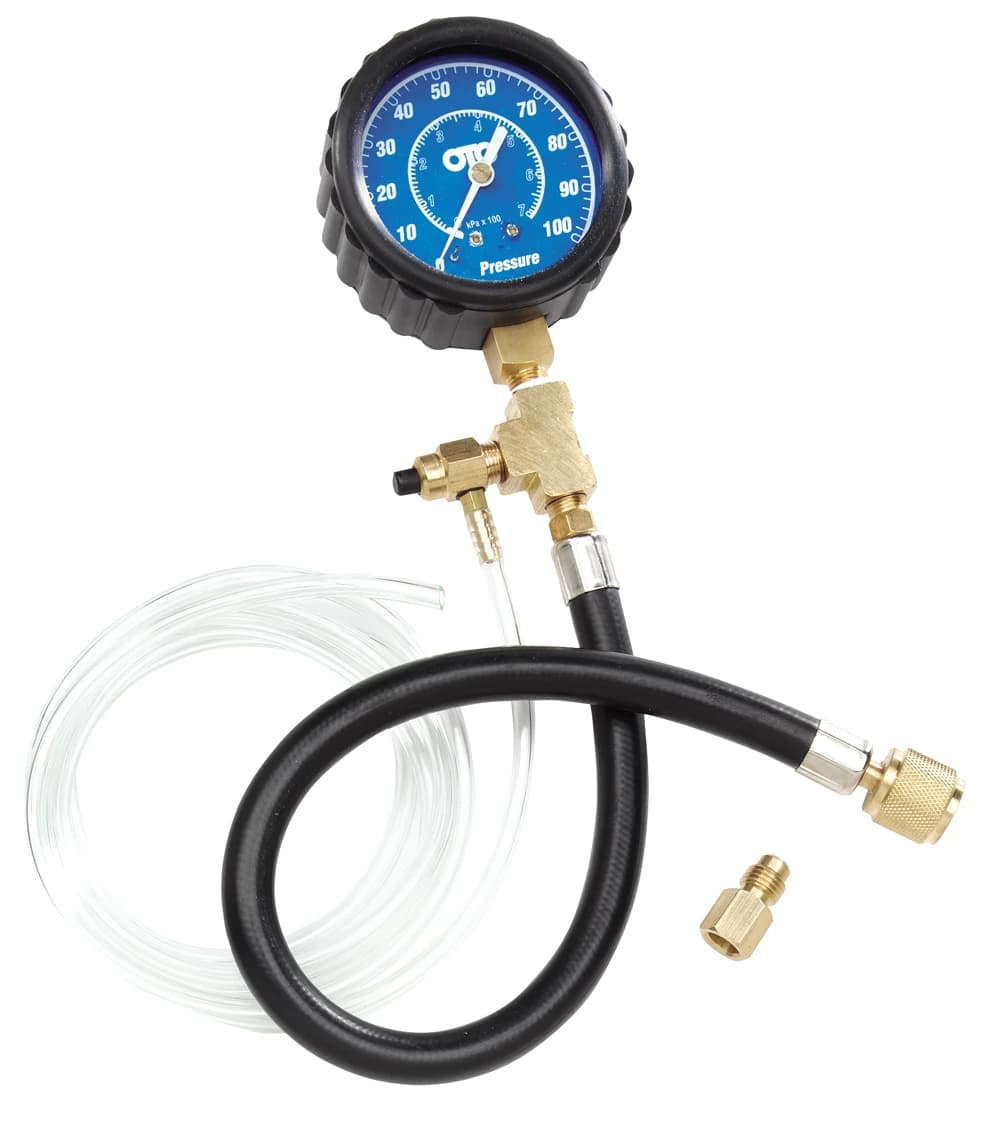
A component-isolation tool
OTC describes the 5630 as a way to locate a malfunctioning fuel filter, pressure regulator, fuel line or fuel pump without removing it from the vehicle. That is a practical diagnostic proposition: the gauge is intended to observe system pressure while the component remains in its circuit. It is not described as a general engine analyzer, and it does not include the vacuum scale of the 5613 or the dual-gauge leakage arrangement of the 5609. The strongest fit is a fuel-pressure work order with a known test port and specified range.
Range and readability
The large gauge is marked 0–100 psi and 0–700 kPa. Those paired units make the 5630 easy to align with service information written in either convention, while the broad face should be readable from the front of an engine bay. OTC does not state accuracy, pointer damping, calibration status or a graduation interval on the page. Therefore, the review can recommend the published range and legibility, but cannot turn the 0–100 psi label into a claim about precision. A vehicle-specific specification remains the controlling reference.
Brass fittings and relief valve
OTC specifically calls out solid brass fittings and a pressure-relief valve for safe, clean testing. The materials claim suggests a robust connection component, while the relief valve addresses controlled pressure release rather than leaving the operator to improvise. The page does not say how the valve is operated, where it discharges, or which hoses and adapters are included. Those details are important in practice, particularly around fuel, so a buyer should inspect the kit contents and follow the vehicle procedure rather than infer a universal connection set.
Fitment is the unresolved variable
The 5630 page says what the kit diagnoses but does not give a list of fittings, thread sizes, hose length or vehicle applications. That is the central buying caveat. “Fuel pressure tester” is not enough information to establish compatibility with a particular port, fuel type or injection architecture. OTC’s wording supports use for filters, regulators, lines and pumps; it does not publish a direct-injection or common-rail claim. Confirm the test port, pressure range and connection method before relying on this kit for a specific vehicle.
Storage and portability
OTC lists product dimensions of 11.7 × 4.7 × 1.7 inches and a shipping weight of 1.05 pounds. Those figures describe a slim, light package compared with the cased 5609 and 5613 kits, and they make the 5630 attractive for a compact fuel-diagnostic drawer. The page does not explicitly list a hard case, replacement seals or a maintenance schedule. Owners should protect the gauge and fittings from contamination and keep any vehicle-specific adapters with the kit, because the manufacturer page does not promise a complete adapter inventory.
Where it should not be overextended
The 5630’s 0–100 psi scale may look familiar to anyone comparing it with the 5609, but the instruments serve different jobs. The 5609’s regulated manifold and dual gauges are for cylinder leakage; the 5630’s single large gauge, brass fittings and relief valve are for fuel pressure. The 5613 covers vacuum and low pressure. Those are meaningful differences, not interchangeable marketing labels. Select the 5630 when the repair procedure is explicitly a fuel-pressure check and the connection details are verified.