Coverage as the product idea
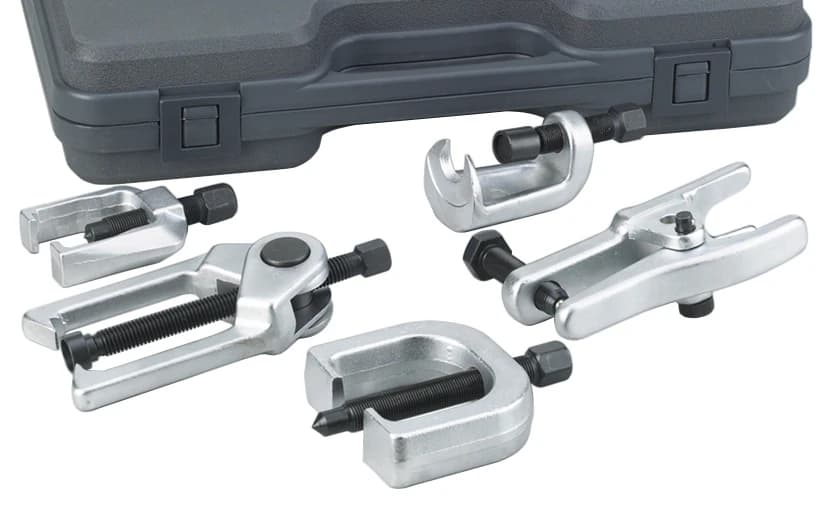
The 6295 is not merely a larger version of one separator. OTC frames it as a five-tool front-end service set for Pitman arms, ball joints, and tie rods on most vehicles. The combination matters because front-end jobs often change tool requirements after disassembly: a puller that suits a Pitman arm is not automatically the right choice for a tie-rod taper or ball-joint joint. By bringing multiple mechanisms together, the kit reduces the temptation to force one tool into an unsuitable role. The remaining responsibility is application selection at the vehicle.
What the five-tool mix means
OTC specifies two Pitman Arm Pullers for large or small ball-joint applications, two Ball Joint Separators, and three different Tie Rod Pullers. That wording describes variety at the category level, not interchangeable jaws. A technician should identify whether the job calls for pulling an arm, separating a joint, or removing a tie-rod end, then select the matching design. The page does not publish each tool’s dimensions or working range, so this review cannot responsibly assign a maximum opening or reach. The useful takeaway is breadth with fitment still unresolved.
Vehicle range and limits
“Most vehicles” is an important but deliberately general phrase in OTC’s overview. It signals intended cross-vehicle utility without replacing a service-manual procedure or an application check. Different knuckles, arms, tapers, and clearances can make a nominally similar job require different contact geometry. The 6295 is therefore best for a shop that sees varied domestic and import work and can identify the correct included tool. It is less compelling for a single platform with a known dedicated fixture, or for anyone expecting the set to eliminate all clearance and access problems.
Ownership and organization
The product page gives the set a 17.6 × 12.5 × 4.2-inch product footprint and 12.3-pound shipping weight. Those figures help place it as a substantial organized kit rather than a pocket tool, although the page does not explicitly describe the case in the published overview. OTC also says all tools can be purchased individually, which is useful for replacing a damaged component or expanding without buying a second full set. Keep threaded forcing components clean and inspect jaws for distortion; the page supplies no additional maintenance schedule or load rating.
How to choose it
Choose the 6295 when front-end service is a recurring part of the workload and category coverage is worth carrying together. Its practical advantage is preparedness: a Pitman-arm job, tie-rod separation, and ball-joint separation are all represented without relying on a generic improvised puller. Skip it when the work is narrowly specialized or when exact application data is mandatory before purchase. The model-specific evidence supports a broad service role, not a ranking against other OTC sets. Use the included tool that matches the assembly and follow the vehicle maker’s removal procedure.