The separation task
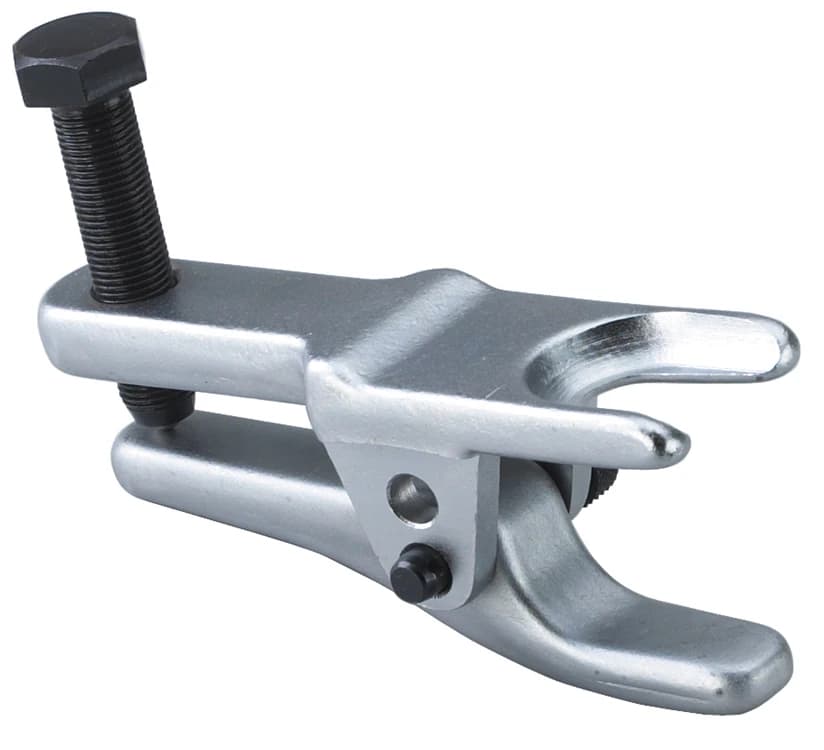
OTC positions the 6297 at a specific interface: separating the ball joint from the spindle support arm. That focus distinguishes it from a press kit, which is used to push components in or out, and from a generic fork that may damage a boot or rely on impact. The 6297’s job is to create separation at the supported joint while its adjustable design accommodates different sizes. Correct seating remains central. A separator is not a substitute for identifying the joint, supporting the assembly, and confirming that the tool’s contact surfaces are on intended metal.
Adjustment and application range
The manufacturer states adjustment up to 2 inches for different-size ball joints and says the tool works on many domestic and import front-wheel-drive vehicles. Those are useful range indicators, but they do not establish that every FWD knuckle will accept the tool. The opening must be sufficient without forcing the frame against nearby components, and the tool must have a straight load path. Because no force rating or detailed jaw drawing is published on the page, a technician should verify the application in the vehicle procedure rather than infer capacity from the two-inch adjustment.
Where it complements a kit
The 6297 is also listed as a steering specialty tool, and its narrow task makes it a logical complement to a broader front-end set such as OTC 6295. Buying the individual separator makes sense when ball-joint separation is the recurring need; a full set makes more sense when Pitman-arm and tie-rod work are equally common. The comparison is about coverage, not performance ranking. The 6297 does not replace a C-frame press or a complete service set because separation and pressing are different operations with different contact requirements.
Size and storage implications
OTC lists product dimensions of 5.6 × 11 × 1.3 inches and a shipping weight of 2.85 pounds. That is compact enough to assign a dedicated place in a mobile or shop toolbox, while still signaling that it is a substantial mechanical separator rather than a small hand fork. The page does not state a case, lubrication schedule, or replacement-jaw policy. Ownership should therefore center on keeping the threaded adjustment clean, checking the frame and contact surfaces before loading, and storing it so the mechanism is not bent or contaminated.
A disciplined fitment decision
The right reason to select the 6297 is its defined task plus adjustable opening, not the assumption that “many domestic and import” means universal. Before use, compare the tool’s available adjustment and access with the spindle support arm; if the joint sits at an angle or clearance is restricted, stop and choose another method. The source supports a broad front-wheel-drive service role, but not a vehicle-specific guarantee. For a technician who routinely faces this separation step, the focused design can be more sensible than carrying a large set of unrelated pullers.