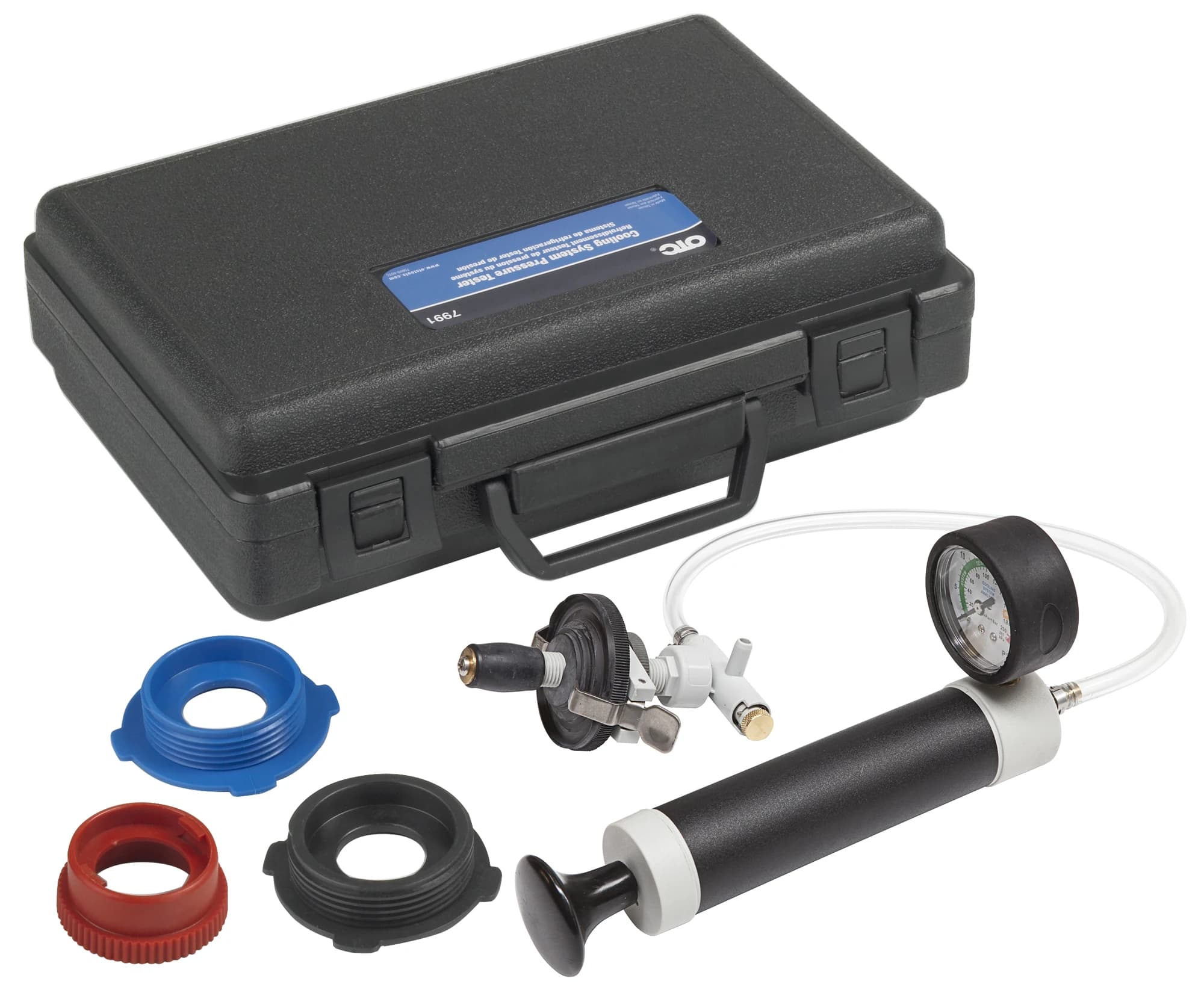
Positioning and intended job
OTC describes the 7991 as a cooling-system pressure tester. The page’s headline application is leak-oriented service across most cars, light commercial trucks, motorcycles, and marine applications. Its universal-fit design is meant to eliminate the need for multiple adapters. That makes the model a focused choice for pressure-testing work rather than a general cooling-system refill machine. The page does not describe a vacuum refill function, coolant exchange, or a separate temperature-dependent workflow, so those capabilities should not be attributed to this exact product record.
Coverage is broad but not unlimited
The most useful part of OTC’s description is its limitation notice. The 7991 will not work on Saturn and Kia cars or on a Jeep with the plastic reservoir. Those exclusions materially change the meaning of “universal fit”: the design seeks broad coverage, but the manufacturer has identified vehicle families or reservoir configurations outside the stated envelope. A shop should therefore screen the vehicle before relying on the tester. The source does not identify model years, adapter geometry, or a cross-reference table, so finer compatibility claims remain unresolved.
What the page does and does not document
OTC lists the product category as Specialty Tools, Coolant, and Motorcycle. It supplies product dimensions of 12.4 by 8.9 by 4.1 inches and a shipping weight of 3.25 pounds. However, the page does not state gauge range, pressure units, pump construction, hose length, adapter count, or service parts. Those omissions matter when comparing a pressure tester with more fully specified kits. The most defensible review is consequently about application scope and footprint, not unverified measurement performance or package contents.
Practical workflow implications
A universal-fit pressure tester is valuable only when its interface seals the vehicle’s filler neck or reservoir. OTC’s explicit exclusion for Jeeps with plastic reservoirs signals that reservoir construction or geometry can defeat the intended fit. Since no step-by-step procedure appears on the product page, the operator should follow the vehicle manufacturer’s service procedure and confirm the 7991’s fit before pressurizing. This is also why the record avoids inventing a maximum pressure or a claim about diagnosing a particular leak location: neither appears in the manufacturer source.
Ownership and shop placement
At the stated 12.4 by 8.9 by 4.1-inch product footprint and 3.25-pound shipping weight, OTC presents the 7991 as a relatively contained piece of equipment rather than a large multi-adapter case. The source does not identify replacement seals, pump parts, gauge parts, or a case. That leaves maintenance and long-term serviceability less documented than the application claim. A shop evaluating ownership should treat the published dimensions and exclusions as verified, while seeking current accessory and repair information separately before making a fleet-wide purchase decision.
Bottom line for fit-first buyers
The 7991 is a sensible shortlist candidate when the intended vehicles fall within OTC’s stated coverage and the explicit exclusions are acceptable. Its differentiation is not a published measurement range or a rich accessory list; it is the promise of universal fit across several vehicle types. Compared with the MV4533 in this collection, it is described as a pressure tester, not a vacuum refill system. Compared with OTC’s 5606, it addresses cooling systems rather than cylinder compression. Those distinctions keep the tool selection tied to the diagnostic task.