Active testing rather than passive measurement
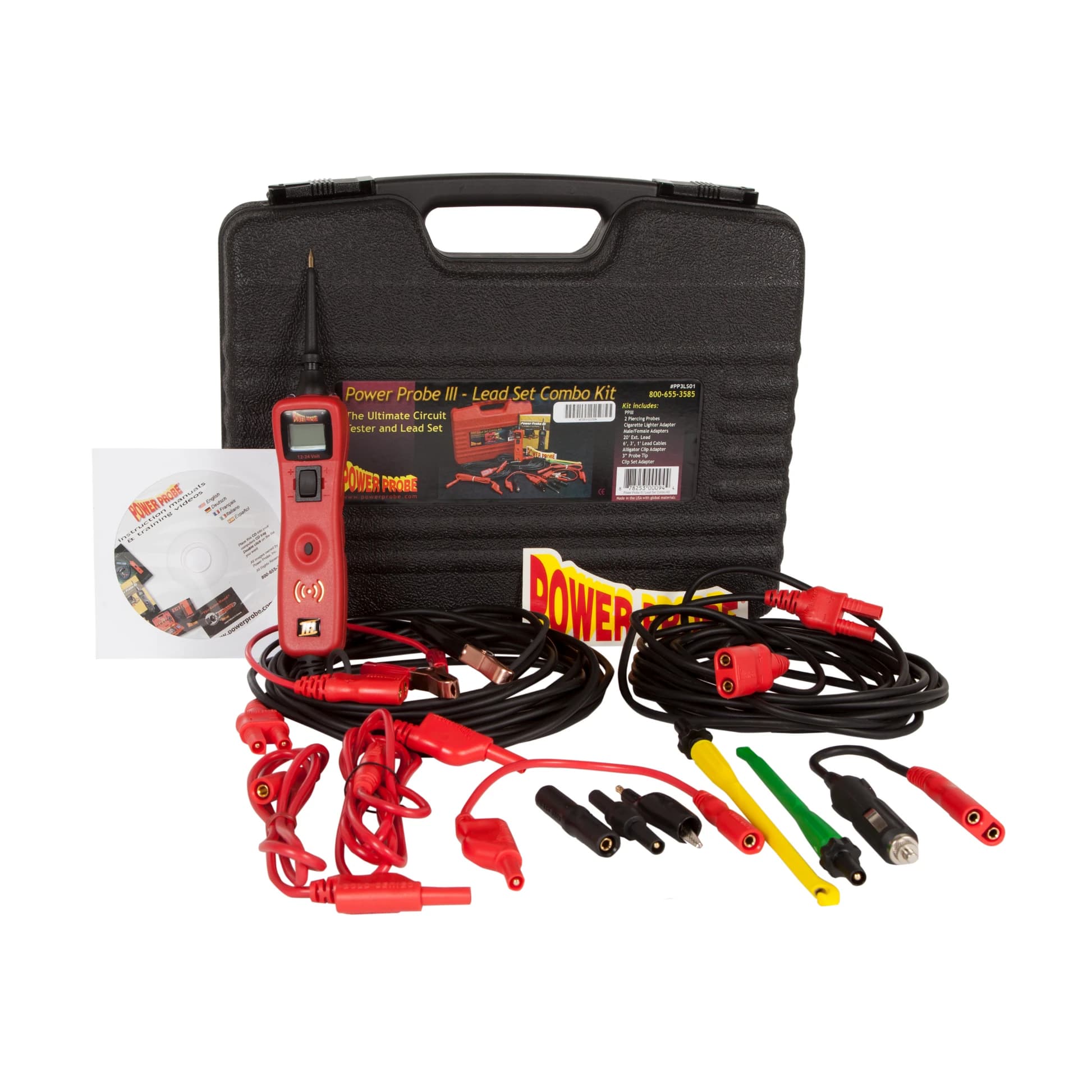
The PP3LS01 pairs the Power Probe III with a Gold Series lead kit, so its central value is two-way diagnosis. The product page describes voltage, polarity and continuity checks alongside the ability to apply battery power or ground at the probe tip. That makes it relevant to tracing an open feed, checking a relay or exercising a suitable lamp or motor. It is a different category from the mechanical ratchets and impact wrenches in this group: the purchase case rests on electrical reach and circuit interaction, not fastening force.
Reach and connection flexibility
Reach is a genuine model-specific strength. The tester carries a standard 20-foot power cable, and PP3LS01 adds another 20-foot extension for approximately 12 metres of combined reach. The Gold Series set supplies 1-, 3- and 6-foot leads for shorter bench or vehicle connections. Two piercing probes, 4 mm male/male and female/female adapters, an alligator-clip adapter and a cigarette-lighter adapter broaden the ways to reach a test point. The moulded case matters here because loose adapters and leads are otherwise easy to misplace.
What the display and indicators can tell you
The digital voltmeter is specified for 0 to +70 V DC plus one digit, with peak-to-peak voltage also listed from 0 to +70 V. The page says the tester captures minimum and maximum voltage, while red/green indicators and audible feedback help identify polarity and continuity. Dual work lights illuminate the area around the three-inch probe tip. Those features should make intermittent or awkwardly located wiring easier to investigate, but the published information does not establish waveform display, data logging or scan-tool communication; those capabilities should not be inferred.
Power injection and circuit discipline
The rocker switch can supply battery power or ground at the probe tip when checking suitable relays, lamps and motors on 12/24 V DC systems. The same page explicitly says to confirm that a component can accept battery voltage or ground before applying power. An 8 A thermal circuit breaker resets manually after a trip. That is useful protection for an accidental overload, but it does not make an unknown module safe to energize. Piercing probes also puncture insulation, so the technician must account for the resulting entry point during repair and sealing.
Ownership and kit completeness
PP3LS01 is a complete lead-oriented package rather than a bare tester: the box list includes the red Power Probe III, battery clips, extension, three Gold Series leads, piercing probes, adapters, alligator and cigarette-lighter adapters, probe tip and moulded case. The product page links a user manual, but this review relies on the displayed product information rather than claiming a procedural test. The 12–24 V operating range and manual-reset breaker should be kept visible in shop instructions. Ownership is easiest when the case is used to preserve the kit’s model-specific accessory set.
Who should choose it
Choose the PP3LS01 when electrical fault-finding is the job and a long tether plus interchangeable connection hardware will save time. It can complement, rather than replace, a multimeter or scan tool: the page documents fast voltage/polarity/continuity checks and active power/ground application, not vehicle-network diagnostics. Compared with the listed fastening tools, its limitation is not mechanical strength but electrical responsibility. A technician who mostly needs to tighten fasteners will gain little; an automotive electrician or restoration technician working across a large vehicle can make much better use of the reach.