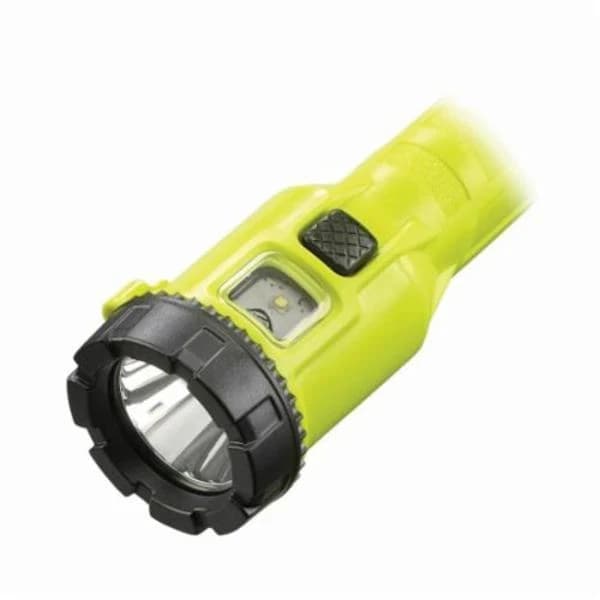
A two-beam work pattern
The Dualie 3AA’s defining idea is not simply brightness; it is coverage. Streamlight gives it separate spot and flood LEDs and a combined spot/flood mode, so the user can see ahead while also lighting the immediate work area. The company explicitly describes the beams as intersecting for path illumination with no blind spots. For automotive work, that layout suits walking to a vehicle, looking into a bay and keeping a downward reference. It is more task-oriented than a single forward beam, though the review does not claim hands-on performance.
Output and runtime trade-offs
Streamlight lists 140 lumens for spot, 140 lumens for flood and 245 lumens for the combined mode. The spot beam reaches 171 m, while the flood beam reaches 8 m; runtimes are 18 hours for either individual mode and 9 hours for the combined mode. That split is useful when choosing a setting: the brightest combined output costs runtime, while the individual modes last longer. The page also lists 7,300 candela for spot and 80 candela for flood, clarifying that the modes are optically different, not merely dimmer and brighter.
Controls and hands-free carry
Dual head switches on either side of the body allow beam selection and one-handed operation. Streamlight also specifies an integrated, snag-free clip that conforms to shirts, pockets and gear; the magnetic model adds a magnetic clip with an integrated hang hook. The page distinguishes the non-magnetic model at 7.0 inches and 6.8 ounces with alkaline batteries from the magnetic model at 7.5 inches and 7.1 ounces. That variant split is important: do not transfer the magnetic model’s dimensions to the yellow non-magnetic package without checking.
Ruggedness and hazardous-location claims
The body is described as durable, non-conductive and corrosion-proof polymer resin with a stipple texture, while the face cap and side lens are unbreakable polycarbonate with scratch-resistant coating. Streamlight rates the light IP67, waterproof to 1 meter for 30 minutes, and 2 m impact resistance tested. The product page also displays Class I/II Division 1, Groups A-G; Class III; and Class I Zone 0 IIC/T4-related markings. These are specific certifications and conditions, not permission to ignore the site’s own hazardous-area requirements.
Battery ownership
The page says the light includes three AA alkaline batteries, also accepts AA lithium batteries and uses mechanical battery-polarity protection. That makes the yellow configuration straightforward for a shop that wants field-replaceable cells rather than a charging dock. The trade-off is that the page does not describe rechargeable AA chemistry performance, charging, or a battery-fuel indicator. If the light will live in a service truck, carry spare cells and preserve the exact battery and clip configuration used for the applicable approval.
Where it fits—and where it does not
The Dualie 3AA is best understood as a compact area-and-path work light, not a rechargeable inspection camera or a high-output searchlight. Its 245-lumen combination mode is useful for broad immediate illumination, while the 171 m spot figure favors reach. The same page lists optional helmet and mounting accessories, but those do not turn the light into a different product class. Choose it when the two-beam pattern, AA supply and certifications match the task; avoid buying on lumens alone.