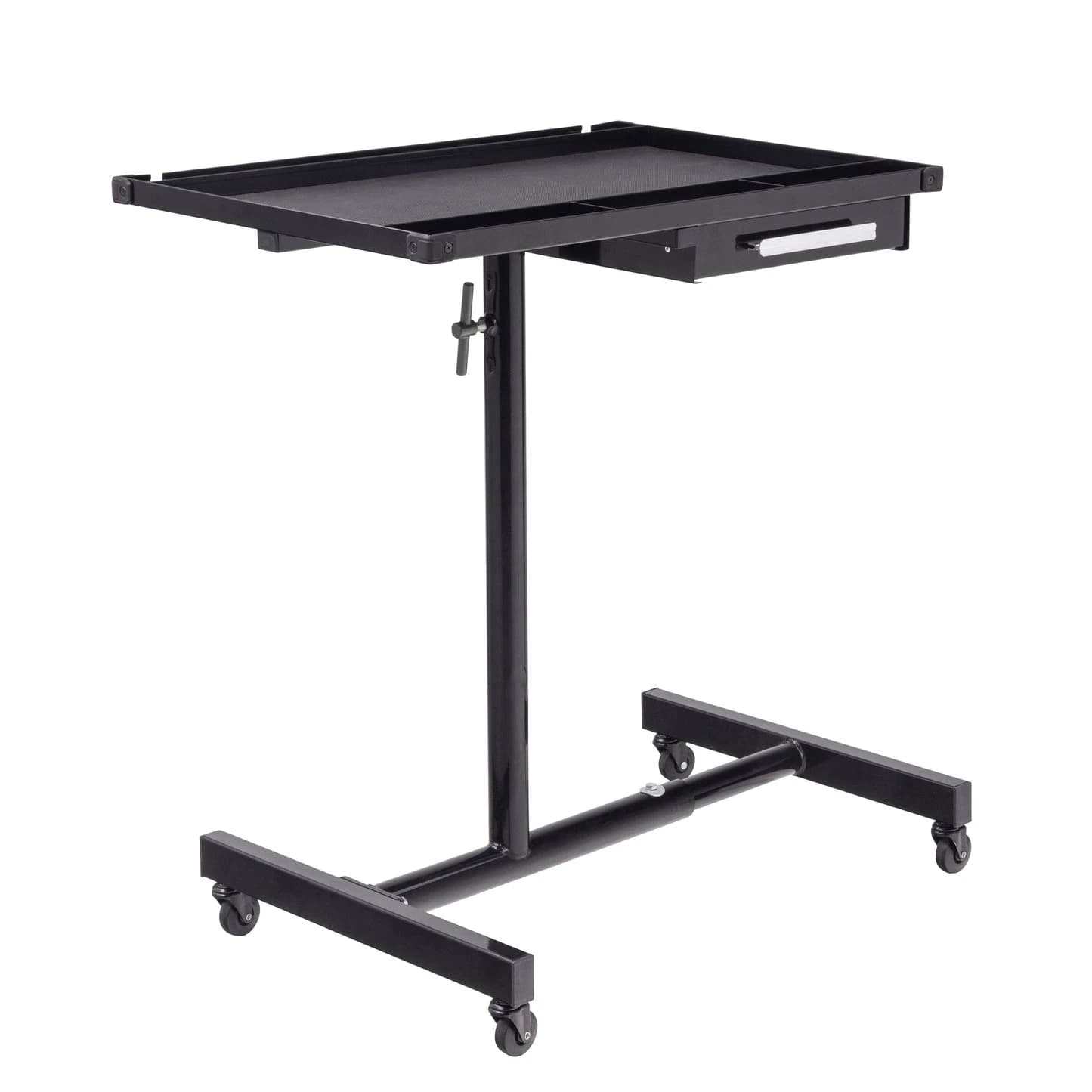
A mobile surface, not a support stand
SUNEX positions the 8019B as a technician workstation with a 220-pound capacity, adjustable 34-to-47.75-inch height, and four casters. That is a useful distinction in an automotive bay: the table is for staging tools, parts, and components beside the vehicle, not for supporting a vehicle or a person. The black B-suffix model is the product page’s exact model, so this review does not substitute the red 8019. The manual’s warnings reinforce the intended role by prohibiting standing on or sitting on the tray and warning against tipping.
Height range and task fit
The height adjustment is the 8019B’s most consequential feature. At 34 inches it can serve a lower seated or component-sorting position; at 47.75 inches it brings a working surface closer to standing height. Adjustment is mechanical: the manual lists an adjustable tube and T-bolt, and the assembly instructions say to slide the tube to the desired height before securing it. That design is simple and serviceable, but it is not a powered or continuously fine-adjustable column. Plan the height before loading the table, and treat the T-bolt as a setup fastener rather than a movement control.
Surface organization for automotive work
The layout is more task-specific than a bare rolling table. SUNEX lists a 2-inch-deep slide-out drawer, three 1-inch-deep tray sections, rubber work-surface mats, protective rubber corner bumpers, screwdriver and pry-bar holders, and air-tool cutouts. In practice, that maps neatly to separating fasteners, clips, sockets, and hand tools while keeping a pneumatic tool upright. The manual gives the top tray’s overall dimensions as 28-7/8 by 19-7/8 by 1 inch, with a 28-1/2 by 16-7/8-inch main area and 9-1/2 by 2-3/4-inch side compartments. It is an open staging system, not weatherproof storage.
Steel construction and maneuvering limits
The manual identifies 1.5 mm gauge steel for the tray and lists 32-3/4 inches overall length, 20-3/8 inches overall width, and 39.7 pounds shipping weight. Those details suggest a substantial shop object, while the rubber bumpers and mats are aimed at protecting work surfaces and nearby vehicle finishes. The same manual says the table rolls easily on flat surfaces, should not be used on uneven or inclined surfaces, and should not be pulled. That is a meaningful ownership caveat: reposition it by the intended handling method on a level floor rather than treating the casters like cart wheels for thresholds or slopes.
Assembly, inspection, and maintenance
Assembly requires 17 mm and 14 mm wrenches. The manual describes fitting four casters, joining the supports, sliding in the adjustable tube, securing the tray with the T-bolt, and installing the four rubber corner bumpers. It also lists replaceable individual items including bumper sets, red or black 2-inch casters, and a rubber mat set. Before use, SUNEX says to inspect the table and not use it if parts are loose or damaged. That combination is encouraging for basic upkeep, but the manual does not promise that every component is user-serviceable; treat the listed replacement parts as the supported maintenance path.
Load planning and ownership boundaries
A 220-pound rating is useful only when the load stays within the table’s design and the floor is suitable. The manual says not to exceed that rating, and also warns that the table can tip or fall. Because the tray is open and only 1 inch deep in its organized sections, heavy or tall items should be positioned deliberately rather than stacked high at the edges. The 8019B makes sense for a controlled bay where a tech can keep parts visible and close. It makes less sense as an improvised platform, a seat, or a substitute for a properly rated lifting or support system.