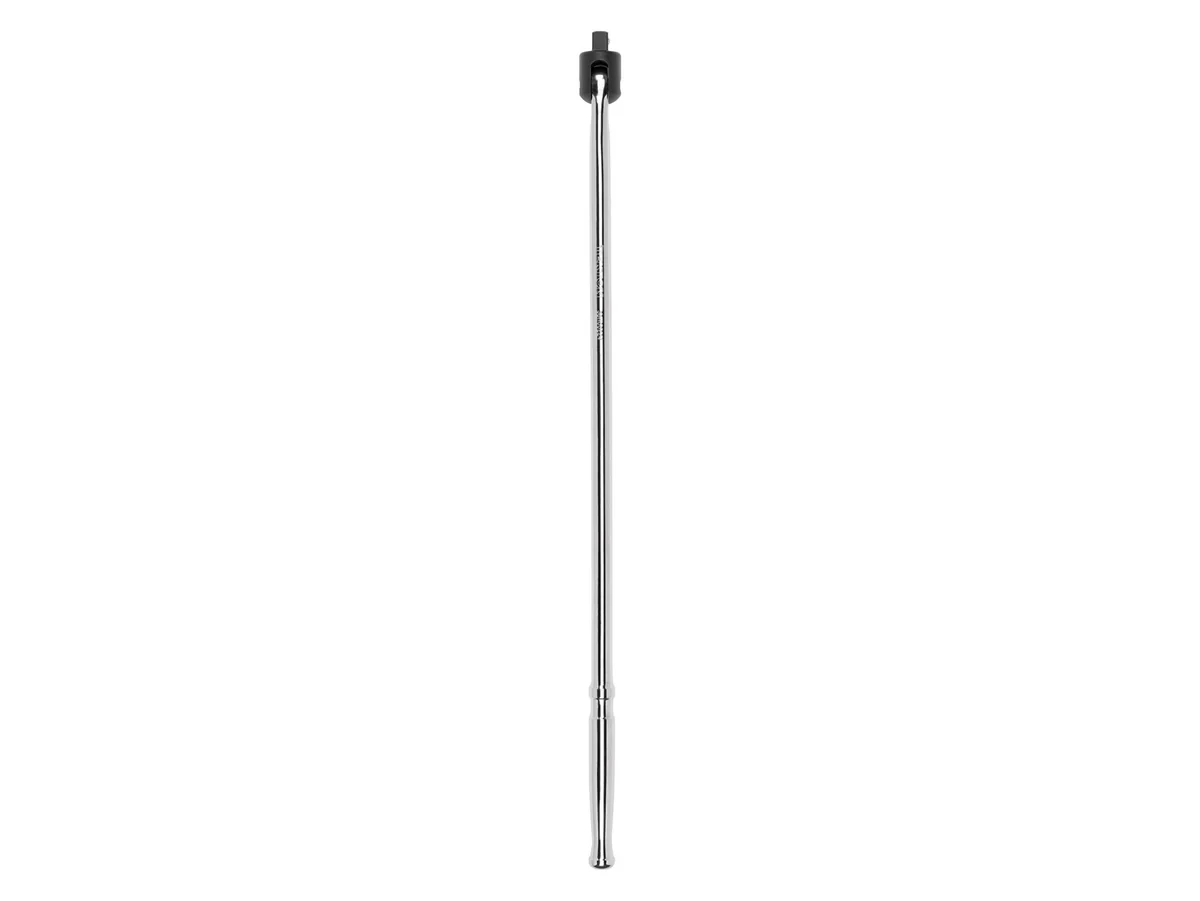
Why keep a dedicated breaker bar
A breaker bar applies manual leverage without asking a precision torque wrench to perform seized-fastener removal. The SBH00224’s 24-inch overall length gives more handle reach than a compact ratchet, which can be useful for a controlled initial breakaway. It does not tell you the torque applied or establish what the fastener can safely tolerate.
The pivot head is an access feature
TEKTON lists a 230-degree pivoting head and an external-head design. The head can help align the handle with available space, but the socket must remain properly engaged. Check whether the handle can move through the likely release path without striking nearby components or trapping fingers. Avoid assuming the pivot makes an awkwardly angled socket connection suitable.
Socket condition and loading still matter
Use a correctly fitting socket and inspect the drive components before applying force. A long handle makes poor seating and damaged hardware more consequential. Follow the vehicle removal procedure, including any direction or fastener-renewal requirement. Do not add an improvised pipe extension or strike the bar as a way of creating an unverified loading arrangement.
Compare the complete fastening sequence
A Milwaukee or DEWALT impact can speed suitable removal jobs, but needs batteries and rated sockets. This bar provides a manual option without those dependencies. After removal and assembly, use a torque wrench such as the appropriately ranged TRQ52403 for specified tightening. TEKTON describes serviceable head components, so retain the model information when identifying replacements rather than treating any similar pivot hardware as interchangeable.