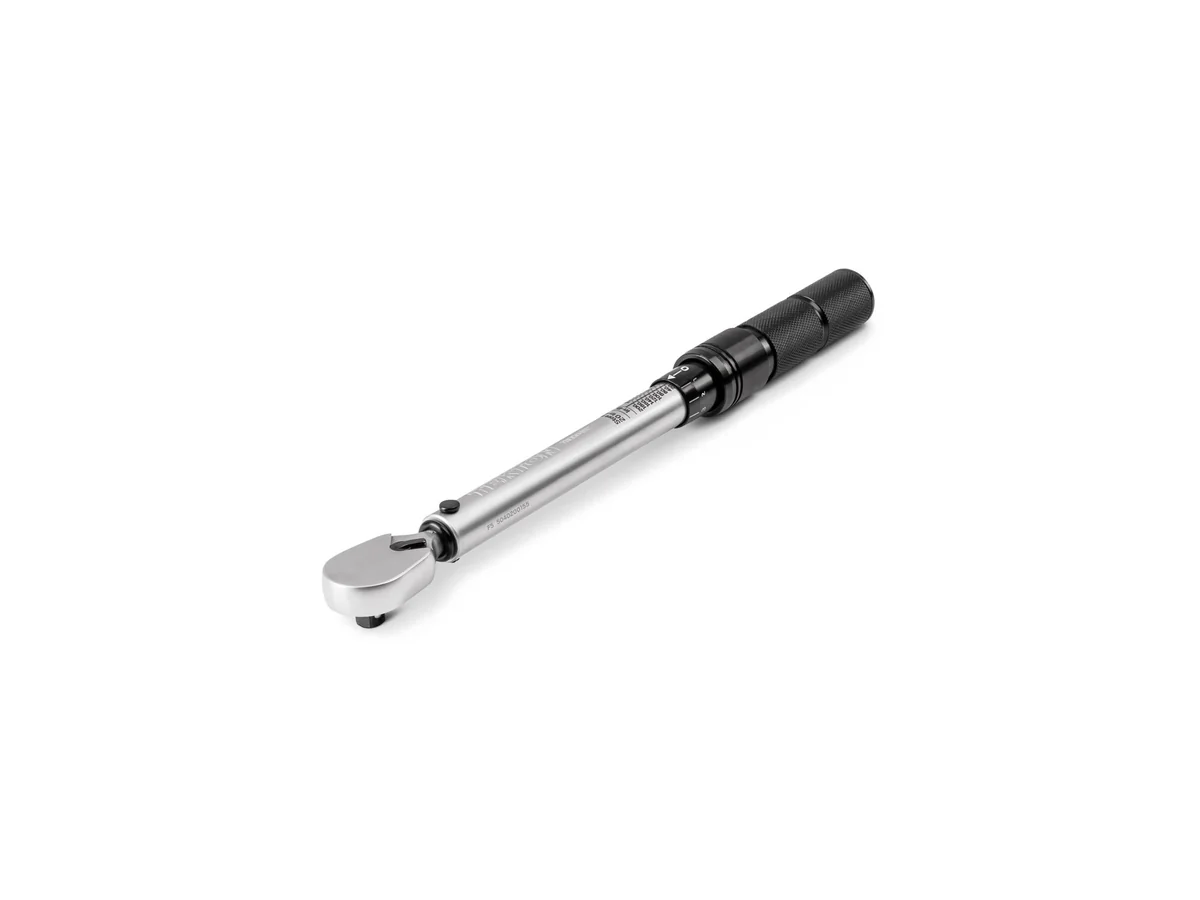
Build the torque kit around the low end
Many workshop mistakes start with using a large wrench for a small specification. TRQ50402 starts at 20 in-lb and stops at 200 in-lb, giving it a different purpose from the 40–300 ft-lb TRQ52403. Compare the fastener requirement with the marked range before considering the drive size. Do not extrapolate below the lowest marked setting. If the procedure specifies 10 or 15 in-lb, a separate appropriate instrument is required.
Dual-direction calibration is the relevant feature
TEKTON specifies measurement in both clockwise and counterclockwise directions within ±3%, with a serialized calibration certificate. That is a stronger buying basis than merely seeing a reversible ratchet lever, because reversing a ratchet does not by itself establish calibrated measurement in both directions. Check the certificate supplied with your wrench and follow the manual for setting and use. The published figures are manufacturer specifications, not independent accuracy measurements by this site.
Access and the click signal
The 90-tooth head has a nominal four-degree ratcheting arc, useful when handle movement is restricted. The fixed head and socket still have to align with the fastener; tooth count does not solve an obstructed approach. Apply force using the specified hand position and stop at the mechanical indication. Small fasteners can be damaged by continuing to pull after a click, using the wrong unit or ignoring thread-condition instructions. Vehicle service information supplies the target and sequence.
A complementary tool, with calibration care
Store and handle the wrench as a measuring instrument, retaining the case and serial-matched certificate. Follow TEKTON’s storage instructions and review recertification needs after abnormal loading or damage. The GEARWRENCH 85062M and larger TRQ52403 cover different ft-lb work; neither is a direct substitute for this inch-pound range. Plan the set around your actual minimum and maximum requirements so that adapters and overlapping purchases do not disguise a gap in usable coverage.