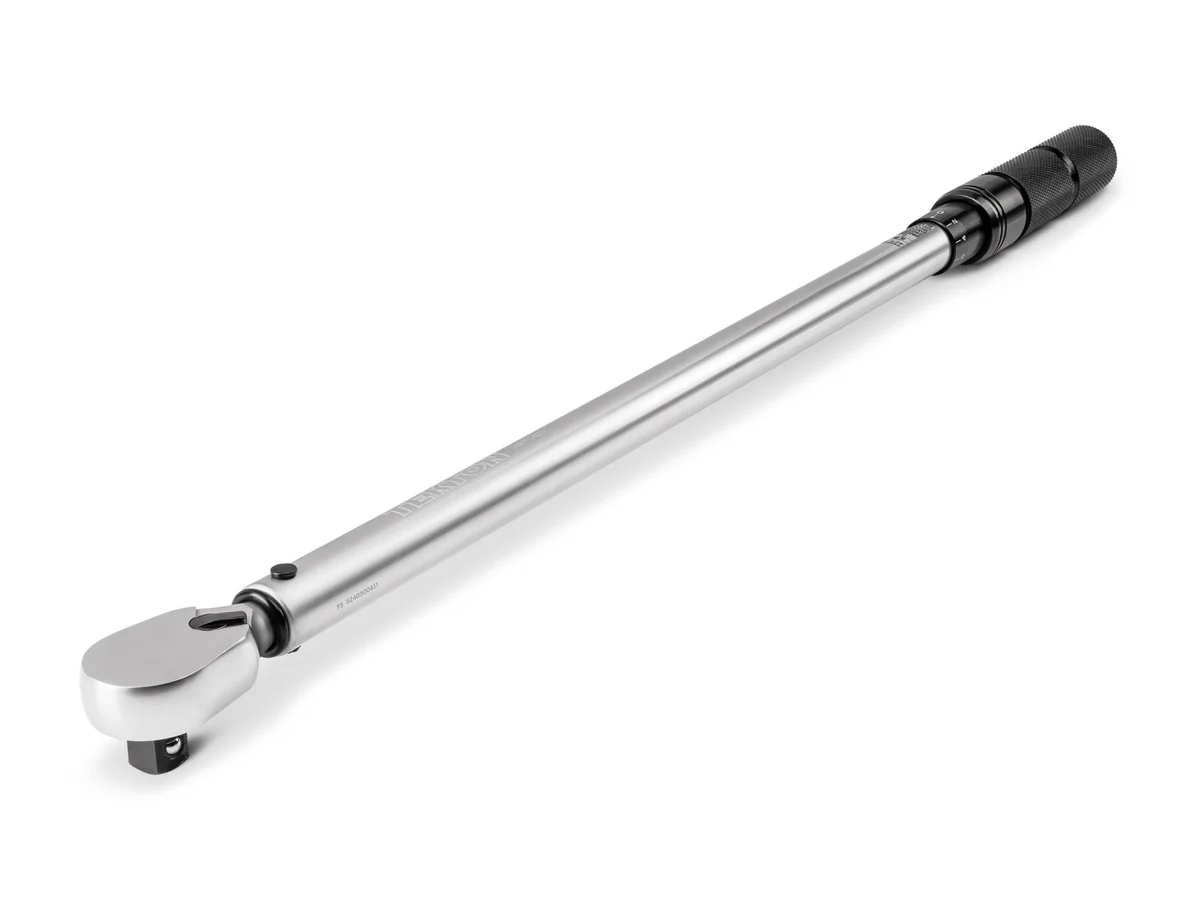
Range matters more than maximum torque
The 40–300 ft-lb range suits a different job from a small inch-pound wrench. Start with the vehicle fastener specification and check that the entire required operation lies within this range. The TRQ52403 cannot provide a documented 25 or 35 ft-lb setting just because an older TEKTON wrench could. Its 2 ft-lb minimum scale increment is also relevant when choosing a target. A larger drive or longer handle is not evidence of better suitability for small fasteners.
Accuracy, direction and the certificate
TEKTON specifies accuracy within ±3% clockwise and counterclockwise, with calibration test points at 40, 180 and 300 ft-lb. The product documentation references ISO 6789-1:2017 and ASME B107.300-2021 and describes a serialized certificate matched to the wrench. Those are manufacturer calibration claims, not measurements by TradeGear HQ. Preserve the certificate and inspect the serial match on receipt. Initial calibration does not establish indefinite accuracy after a drop, overload or years of service; review the recertification guidance for continued precision work.
Units and tightening technique
This specific model has a single ft-lb scale, not a dual ft-lb/Nm scale. Convert a metric service specification carefully before setting it, and avoid confusing in-lb with ft-lb. Its mechanical click signals the selected torque; it does not automatically stop all further force. Use the manual’s handle position and a controlled pull, and stop at the indicated signal. The wrench does not determine the vehicle torque value, required thread condition or tightening sequence. Those remain requirements of the service information.
The 90-tooth head helps access, within limits
The fixed head has a nominal four-degree ratcheting arc. That can reduce the handle movement needed to take another bite in restricted spaces, but the 26.1-inch overall length still needs a clear working path. A fastener beside a chassis member may need a different head arrangement even when the torque range is correct. Extensions and drive adapters also need appropriate ratings and geometry; the included 1/2-to-3/8-inch reducer does not make a small socket automatically suitable for 300 ft-lb.
Storage and ownership
The supplied case protects the wrench and keeps the calibration certificate and manual together. TEKTON instructs storage at the lowest setting to relax the adjustment spring; that means the lowest marked setting rather than winding below the scale. Keep a separate breaker bar for loosening seized fasteners and do not treat the torque wrench as an impact accessory. The manufacturer offers a recertification service, so include transport and downtime in your ownership plan if the tool will support regular documented workshop work.
How it fits alongside the other torque choices
The TRQ50402 measures 20–200 in-lb with a 1/4-inch drive, making it a complementary small-fastener instrument rather than an alternative for wheel torque. The GEARWRENCH 85062M covers 10–100 ft-lb with a 3/8-inch drive and fills part of the lower-range gap, but its published clockwise accuracy condition is different. Choose by the required units, range, direction and access. For a torque-plus-angle procedure, neither the maximum torque figure nor a reversible ratchet replaces a suitable angle-measuring method.